
How many decades of club history are currently gathering dust on a shelf, visible only to those standing directly in front of a trophy cabinet? Most committee members view their trophy room with immense pride, but they also recognise the growing administrative weight of managing searchable sports club winner records. It's a daunting reality that decades of achievements are trapped in silver and brass, vulnerable to being lost or forgotten if they aren't properly documented. You shouldn't have to choose between preserving your past and spending hundreds of hours on manual data entry.
We believe that preserving these stories is a noble task that should be efficient rather than overwhelming. This guide shows you how to transform physical engravings into a digital archive that preserves your club’s legacy for future generations. We'll explore how AI-powered transcription can modernise your club heritage by creating a digital honours board and a portable CSV archive. You'll discover a methodical way to move from physical clutter to digital order, ensuring every name from your club's past remains visible and protected forever.
Key Takeaways
- Learn why physical trophy engravings represent "invisible" history and how digitisation ensures your club's legacy is never lost to damage or time.
- Discover how to create searchable sports club winner records by categorising metadata, making decades of achievements instantly accessible to all members.
- Understand how AI transcription bridges the gap between physical silver and digital software, accurately capturing engravings from simple photographs.
- Compare the scalability of automated transcription against manual data entry to save your volunteers hundreds of hours of tedious, error-prone typing.
- Find out how to host a digital honours board on your club website, providing a professional portal for members to celebrate their shared heritage.
Table of Contents
The Challenge of Invisible History: Why Physical Records Fail
Physical trophies and wooden plaques are more than metal and timber. They represent the lifeblood of a club's culture. However, when these records remain strictly physical, they often become "invisible history." Most clubs store their heritage in locked glass cabinets or dusty back-office storerooms, making the creation of searchable sports club winner records nearly impossible without a digital strategy. This creates a barrier between the history and the people who made it. It's a disconnect that prevents the wider membership from truly appreciating their legacy.
Relying on physical displays often leads to significant data gaps. Manual record-keeping is notoriously inconsistent. A secretary might miss a year, or an engraving might be too faint to read. Over time, these small omissions turn into lost club history. Traditional wooden boards also face a physical limit. Eventually, you simply run out of wall space. In a world where members expect instant information on their smartphones, a stationary board in a clubhouse foyer can feel stagnant and disconnected.
The Risk of Physical Record Loss
Physical archives are inherently fragile. Silver tarnishes, and engravings wear down. Wooden plaques can warp or suffer from damp. Beyond natural decay, clubs must consider the risks of fire, theft, or relocation. When a physical record is destroyed, the data is often gone forever. This is why digitising old honours boards is a priority. Moving records into a digital format creates a permanent backup that outlasts physical objects.
Accessibility and Member Engagement
A photo gallery creates a "searchability gap" where members must scroll through images to find a name. You need searchable sports club winner records that allow for instant filtering. When an alumnus searches for a family name and finds it in seconds, club pride increases. Digital accessibility transforms history from a passive display into an interactive archive. It allows engagement from anywhere. You move from physical clutter to a system that celebrates every winner.
What Makes a Winner Record Truly Searchable?
Modernising your club's heritage requires more than just taking photographs of trophy cabinets. A truly searchable record consists of four key data points: the year of the achievement, the recipient's name, the specific award title, and the competition category. When these elements are extracted and organised, they transform from static text into dynamic metadata. This structure allows you to filter decades of history in seconds, creating searchable sports club winner records that serve both current members and future historians.
The technical foundation of this process is Optical Character Recognition (OCR). This technology identifies the shapes of letters on reflective silver or textured wood and converts them into digital text. It's the essential first step in building searchable sports club winner records. Without OCR, you're simply left with a collection of images. With it, you have a functional database that can be sorted, searched, and preserved indefinitely.
Core Search Functionality for Clubs
Once your data is digitised, it opens up three primary ways for members to interact with their history. Search by Name allows members to trace their family history within the club, revealing every victory a specific individual has achieved across multiple decades. Search by Year is essential for committee members reviewing a specific season or planning an anniversary event. Finally, Search by Trophy provides a complete lineage of a specific shield or cup, showing every guardian of that prize since its inception.
Data Portability and Exports
Clubs should never feel "locked" into a specific software platform. Your history belongs to your organisation. This is why CSV (Comma Separated Values) export functionality is critical for long-term data integrity. A CSV file is a universal format that can be opened in Excel, Google Sheets, or imported into other club management systems. It ensures your records remain portable and under your control.
These exports are incredibly practical for club administrators. You can quickly generate lists for annual award night programmes or include historical data in your annual report without manual typing. Having a digital backup in a portable format ensures that even if technology changes, your records remain accessible. If you're ready to see how your physical trophies look in a digital format, you can start with a free trophy transcription to experience the accuracy of AI-driven archiving.
AI Transcription: The Bridge Between Silver and Software
AI trophy transcription is the process of converting engraving photos into digital text. This technology serves as the essential link between the physical history stored in your clubhouse and the digital accessibility your members now expect. Creating searchable sports club winner records used to require tedious manual labour, but modern computer vision has simplified the entire workflow. You start by taking a clear photograph of an engraving with a standard smartphone. Our AI then processes the image, identifies the text, and corrects for the natural distortion caused by the curvature of silver or wood.
This automated approach drastically reduces human error. When a volunteer manually types out hundreds of names, fatigue leads to mistakes in spelling or dates. AI remains consistent throughout the entire dataset. It doesn't get tired or skip lines. This ensures that every individual name is captured with precision, allowing you to transition from physical clutter to a structured digital order that lasts forever.
How AI Trophy Transcription Works
Specialised algorithms are the heart of this process. They're specifically trained to handle the unique challenges of sports heritage, such as identifying dates on curved shields or reading faint, hand-engraved scripts on tarnished cups. However, we don't rely on technology alone. A "human-in-the-loop" system ensures that every transcription is verified for accuracy by a specialist before it's finalised. This blend of machine speed and human oversight is the most reliable method of modernising club heritage using AI transcription services. It guarantees that your digital honours board is an exact, verified reflection of your true history.
Efficiency Gains for Committees
The efficiency gains for club committees are undeniable. Manually entering records for 100 trophies could easily consume a volunteer's entire month of spare time. AI-assisted transcription completes the same volume of work in a fraction of the time, freeing up your committee to focus on running the club. This efficiency makes professional digitisation feasible for even the smallest, most budget-conscious organisations. By adopting a "pay once" model, clubs can secure their historical data without the burden of ongoing subscription fees for the records themselves. We invite all administrators to use our "Try one free" approach. This allows you to test the technology's accuracy on your most challenging, reflective trophy before committing to a larger project. It's a methodical, risk-free way to begin your transition to a searchable digital archive.
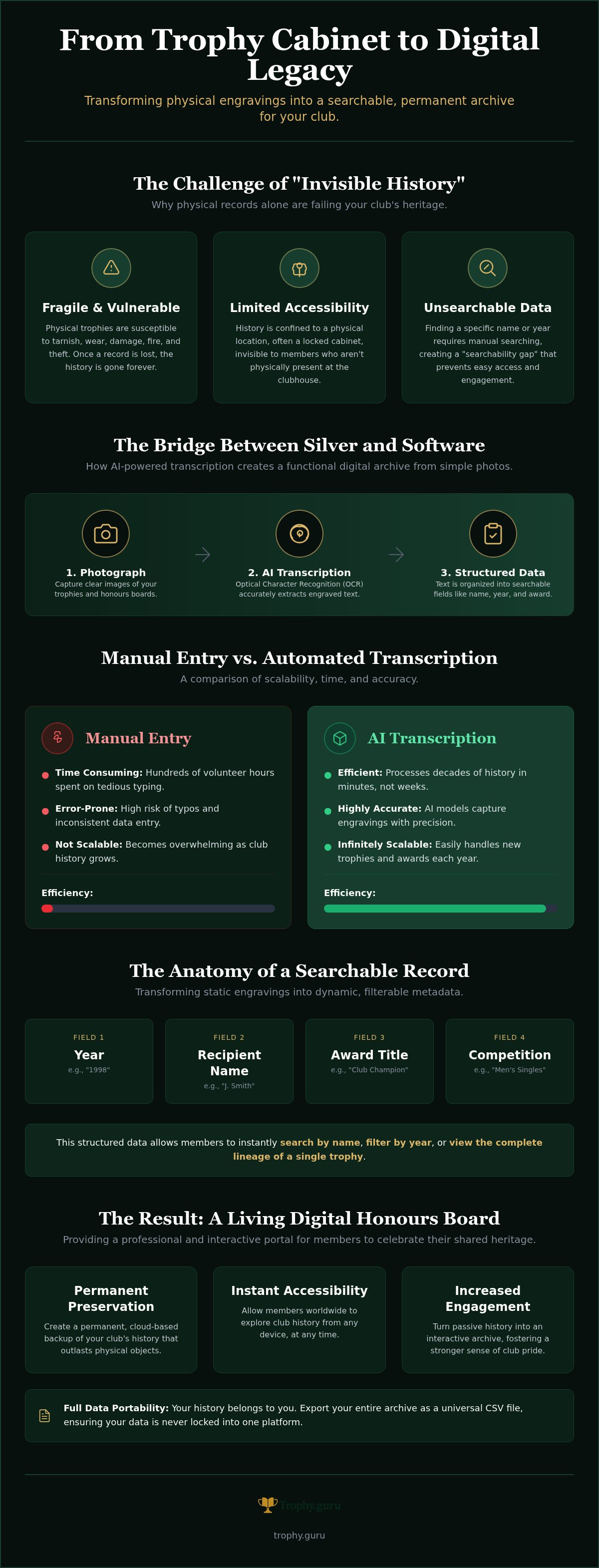
Manual Entry vs. Automated Transcription: A Comparison
Choosing between manual entry and automated transcription is a choice between volunteer exhaustion and technological efficiency. While typing out names might seem like a cost-free solution, it carries significant hidden burdens that can derail a heritage project. The primary challenge lies in maintaining accuracy across hundreds of entries. Manual projects often suffer from "data fatigue," where the quality of the record decreases as the volunteer progresses through the archive. This leads to inconsistent data that undermines the utility of your searchable sports club winner records.
Consistency is the hallmark of a professional archive. A human typist might record a date as "1992", " '92", or "92/93" depending on their mood or the specific trophy's engraving style. Automated systems apply a uniform logic to every entry. This ensures your database remains clean, sortable, and professional from the first record to the five-hundredth. Scalability is also a critical factor. While a volunteer might manage to digitise 10 trophies over a weekend, handling 500 trophies requires a level of stamina that manual entry simply cannot sustain without introducing errors.
The Volunteer Burden
Most manual digitisation projects stall after the first few years of data are recorded. Volunteers often start with high enthusiasm but quickly realise the tedious nature of the task. Reading faded or complex cursive engravings by eye is physically demanding and prone to misinterpretation. Using AI doesn't replace the volunteer; it empowers them. It shifts their role from a data entry clerk to a curator of club history, allowing them to focus on the stories behind the names rather than the mechanics of typing.
Long-term Maintenance
Heritage isn't static. Every season adds new names to your lineage. An automated system makes it simple to ingest these new winners into your existing framework without reinventing the process every year. Unlike complex software subscriptions that require ongoing fees just to view your own data, a "pay once" transcription model ensures your historical backlog is secured forever. This future-proofs your records against changes in club committee members. When a new secretary takes over, they inherit a clean, digital archive rather than a box of loose papers and tarnished silver. If you're ready to move beyond the manual slog, you can start your digital archive today with our AI-powered transcription service.
Launching Your Searchable Digital Honours Board
Once you've digitised your data, the final step is to make it accessible to your community. A digital archive shouldn't just sit on a hard drive; it needs a home where members can interact with it. Most clubs choose to integrate their searchable sports club winner records directly into their existing website. This allows anyone, from current players to distant alumni, to celebrate the club's heritage at any time. You'll need to decide whether to make your archive public or keep it behind a member login. Public archives are excellent for recruitment and community pride, while private portals offer a layer of security for specific historical data.
Engaging your community is significantly easier when the history is visual and interactive. Many clubs are now moving beyond simple lists and creating virtual trophy rooms. These digital spaces allow users to browse through a gallery of their club's greatest achievements in a modern, intuitive format. When you're ready to launch, announce the new archive through your official channels. Use a clear, methodical approach to show members how to use the search features to find their own names or those of their family members.
Choosing the Right Display Platform
You don't need expensive hardware to display your history. While some large organisations install touchscreen kiosks in their foyer, web-based archives are often more practical and cost-effective for most clubs. They require no physical maintenance and are instantly accessible on any device. A mobile-first design is essential. It ensures that members can search for searchable sports club winner records while standing on the sidelines or sitting in the clubhouse. For a detailed comparison of available systems, consult our 2026 guide to digital honours boards.
Promoting Your Digital History
A digital archive is a powerful tool for ongoing member engagement. You can use your records to fuel social media content, such as "on this day" posts that highlight a victory from several decades ago. These posts drive traffic back to your website and spark conversations between different generations of players. Linking your digital archive to alumni newsletters is also a proven strategy for fundraising and long-term support. When former members see their names recorded with such reverence, they feel a stronger connection to the club's future. Encourage your community to contribute by asking members to provide photos or personal stories to accompany the digital records. This transforms your archive from a simple list of names into a living, breathing history of your community.
Secure Your Club's Legacy for the Future
Moving your club's history from a dusty cabinet to a digital platform is more than a technical upgrade; it's an act of preservation. By transforming physical engravings into searchable sports club winner records, you ensure that every name and achievement remains accessible to your community for generations. We've explored how AI-powered transcription removes the burden of manual entry, providing a methodical path toward a structured digital honours board. This transition protects your heritage against physical loss while significantly boosting member engagement.
You can maintain complete ownership of your history with our CSV export functionality and a transparent "pay once" model. There are no recurring fees for extracting your data, and our AI is specifically designed to handle complex silver engravings with precision. Start your searchable club archive with a free trophy transcription and witness how easily your tradition can meet modern technology. Your club's past is the foundation of its future. Take the first step toward a modern, accessible archive today.
Frequently Asked Questions
How do I make my sports club winner records searchable online?
You can make your records searchable by using AI-powered transcription to convert physical engravings into digital text. You start by photographing your trophies or honours boards and uploading them to a platform like Trophy Guru. Our system extracts names, years, and categories to create a searchable database. Once the data is processed, you can host it on a digital honours board that members can access via your club website. This ensures your history is visible to everyone.
Can AI accurately read old or faded trophy engravings?
Yes, modern computer vision algorithms are specifically trained to handle reflective silver surfaces and varied engraving fonts. While extremely faint or damaged text may require human verification, the AI identifies character shapes even on curved or tarnished metal. We use a "human-in-the-loop" system to ensure that every transcription is verified for accuracy. This combination of technology and oversight ensures your historical records are captured correctly and are ready for digital display.
What is the best format for exporting sports club records?
The CSV (Comma Separated Values) format is the industry standard for data portability and long-term ownership. This universal file type can be opened in Excel, Google Sheets, or imported into various club management systems. It ensures your searchable sports club winner records aren't locked into a single software platform. Having a CSV archive allows you to generate annual reports or print programmes with ease while maintaining a permanent digital backup of every winner and award category.
Do I need a subscription to host a digital honours board?
Trophy Guru operates on a "pay once" model for the transcription of your historical backlog. This means you don't face recurring monthly fees just to own or view your data extraction results. While some display platforms may charge for ongoing hosting, our focus is on providing you with complete data ownership through a one-time fee structure. This approach is ideal for budget-conscious clubs looking for long-term heritage preservation without the burden of endless subscriptions.
How long does it take to digitise a club’s entire trophy collection?
The timeline depends on the number of trophies, but AI transcription is significantly faster than manual entry. Once you've taken the photographs, the initial transcription process is often completed within a few working days. This is a fraction of the time it would take a volunteer to manually type out decades of history. It allows your committee to move from physical clutter to a digital archive without a massive time commitment or administrative burden.
Can I export my searchable records to Excel or CSV?
Every transcription project includes the ability to export your data into a CSV file. This file is fully compatible with Microsoft Excel and other spreadsheet software. It gives you the flexibility to sort, filter, and edit your records offline. Ensuring data portability is a core part of our mission, as it allows clubs to maintain their own records independently of any specific hosting service or software provider. It guarantees you always have a copy of your heritage.
Is it possible to include photos of the trophies in the searchable database?
You can link your searchable text records to the original photographs of the trophies. This creates a more engaging experience for members, allowing them to see the physical award alongside the digital entry. Modern digital honours boards often feature these "virtual trophy rooms" to provide a visual connection to the club's heritage. It transforms a simple list of names into a rich, multimedia archive that celebrates the club's achievements and preserves the visual history of the awards.
How do I ensure our club records are ADA or accessibility compliant?
Digitising your records is the first step toward true accessibility. Physical engravings are impossible for visually impaired members to read, but digital text can be processed by screen readers. By converting your searchable sports club winner records into a web-based format, you ensure they meet modern accessibility standards. This allows all members, regardless of their physical abilities, to engage with and appreciate the club's long-standing history and traditions in a way that physical objects don't allow.