
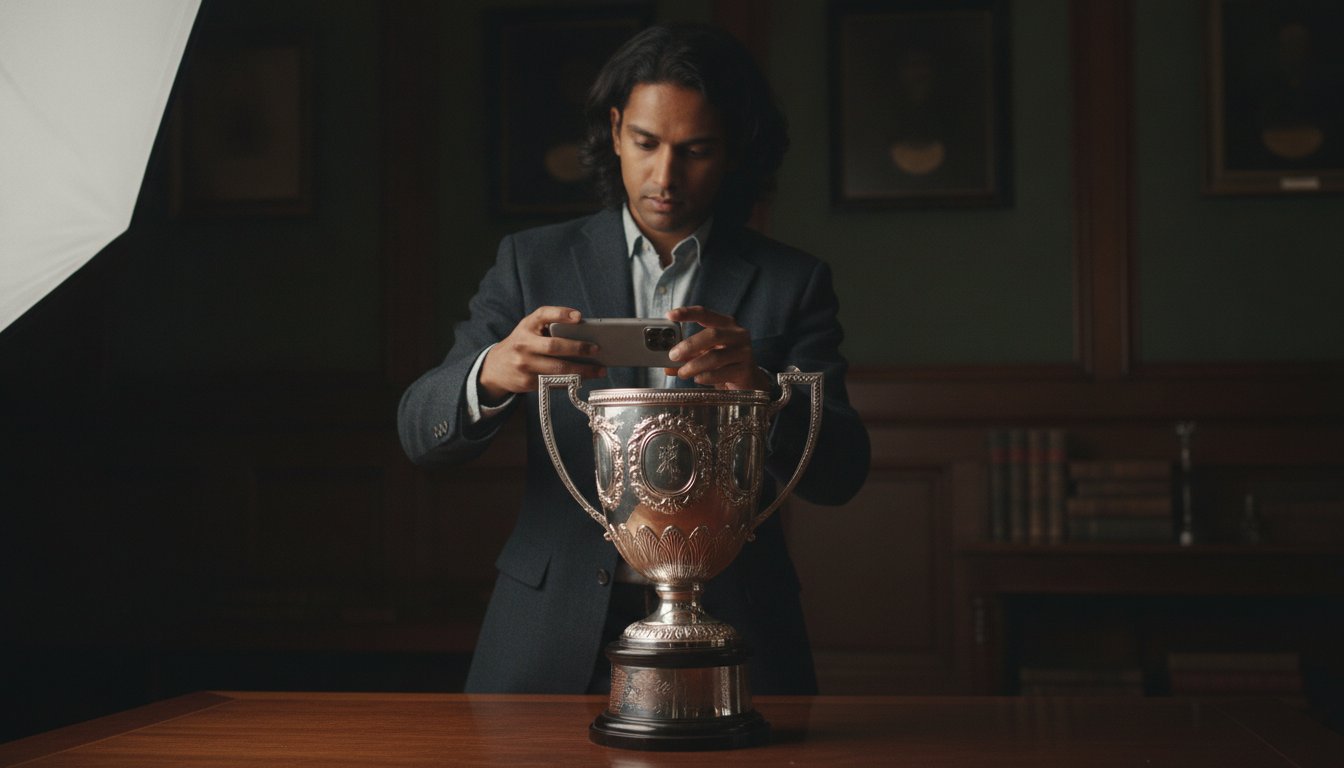
Imagine standing in a dimly lit clubhouse, phone in hand, trying to capture fifty years of winners' names from a silver cup that behaves more like a mirror than a historical record. You need to transcribe names from silver trophies to ensure the club's heritage is preserved, but every camera flash creates a glare that obscures the very history you're trying to save. It's a frustrating, delicate task that often leads to squinting at blurry photos and resignedly typing out hundreds of names by hand.
We understand that your club's history is precious and that manual data entry is a recipe for errors. You shouldn't have to risk typos in a captain's name or spend your weekend hunched over a spreadsheet. This guide promises a better way. You'll learn how to efficiently extract and digitise decades of engraved records without the drudgery of manual typing. We'll walk through the exact steps to capture clear images of reflective surfaces and use intelligent tools to turn those photos into a clean, searchable CSV or Excel file. By the end, you'll have a secure digital honours board that ensures your club's legacy is protected for the next generation.
Key Takeaways
- Identify why reflective silver surfaces cause standard OCR to fail and how specialised AI overcomes the "mirror effect" to read curved text.
- Discover how to transcribe names from silver trophies with high accuracy, saving hours of manual typing and preventing costly historical errors.
- Master the "White Sheet" photography technique to eliminate distracting glares and ensure every engraving is perfectly visible for digital extraction.
- Learn how to export your trophy records into clean CSV or Excel files for seamless integration with modern club management software.
- Explore the process of creating a searchable digital honours board that protects your club's legacy from physical damage or accidental loss.
Table of Contents
The Challenge of Archiving Engraved Silverware
Trophy transcription is the digital bridge between physical awards and searchable member archives. It's the methodical process of converting physical engravings into structured, digital data that can be backed up, shared, and searched. While a wooden honours board stays fixed on a wall, trophies are often moved, polished, and handled. This makes the data they carry uniquely vulnerable. To transcribe names from silver trophies requires a different approach than simply scanning a flat document or photographing a plaque.
Silver trophies present specific hurdles that other commemorative items don't. The surface is rarely flat; it's usually cylindrical, conical, or intricately shaped. This curvature distorts the text as it wraps around the vessel. Additionally, The art of engraving on silver involves cutting into a highly reflective surface. These shallow channels reflect light differently than the surrounding metal, creating a high-contrast environment. It's often difficult for the human eye to read in certain lights and nearly impossible for standard office software to interpret correctly without a specialised workflow.
For many British sports clubs and educational institutions, these trophies represent "Heritage Continuity." They are the physical thread connecting a 1924 winner to a 2024 champion. When this history is trapped on a single physical object, the institution’s legacy is at risk. Establishing a digital record ensures that the names of past captains and champions aren't lost to time or accidents.
Reflections and the Mirror Effect
The high polish of silver is its greatest aesthetic asset but its biggest technical hurdle. Standard Optical Character Recognition (OCR) software is designed to find dark text on light, matte backgrounds. On a trophy, the background is a mirror. This leads to "ghosting," where reflections of the ceiling, the photographer, or room lights are interpreted by software as false characters. If you attempt to transcribe names from silver trophies using manual photography without a plan, you often end up with unusable data or a digital file full of gibberish.
The Risk of Physical Record Loss
Relying on a single physical object to hold a century of history is a liability. Trophies can be lost, stolen, or damaged beyond repair in a fire or flood. By creating a digital backup, you ensure the record survives even if the silver doesn't. These digital archives are also far more useful for club anniversaries and alumni relations. Instead of members squinting at a cup in a locked glass case, they can search a digital honours board from their phones. This transition from physical clutter to digital order turns a static object into a living, searchable piece of history.
Overcoming the Mirror Effect in Trophy Transcription
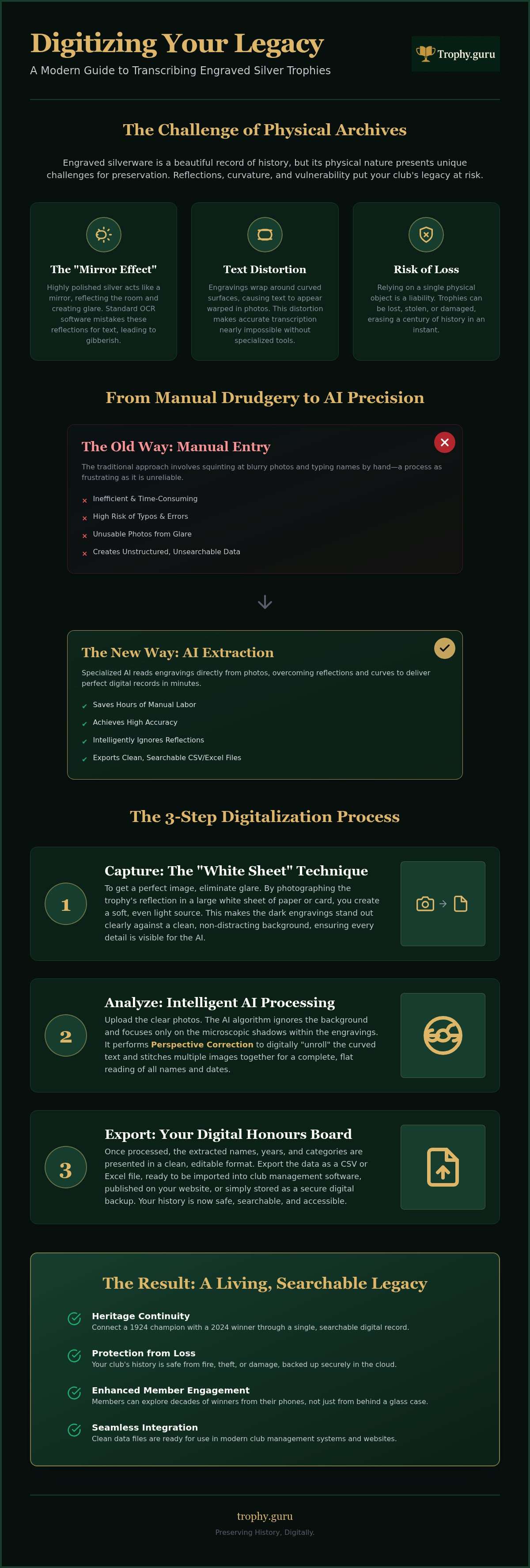
To accurately transcribe names from silver trophies, the technology must differentiate between the physical engraving and the reflected environment. While a human eye might be distracted by the reflection of the room, specialised AI focuses on the microscopic variations in shadow within the etched grooves. Standard scanner apps, designed for flat documents, often fail because they cannot interpret the way light bounces off a curved, metallic surface. They see a mirror; the AI sees a dataset. This distinction is the key to moving from a simple photograph to a verifiable digital record.
Effective transcription relies on maximising contrast. It is the difference between simply "reading" a name and "digitising" a record. Reading is a fleeting observation, but digitising involves extracting that data into a structured format that survives beyond the physical object. While general federal digitization guidelines provide a foundation for preserving historical archives, silver trophies require a more nuanced approach due to their unique geometry. If you're dealing with a particularly complex piece, you can try one trophy transcription for free to see how specialised extraction handles these reflective challenges.
Curvature and Perspective Correction
Engravings on a trophy cup often wrap around the surface, causing text to appear warped or tapered in a single photograph. Advanced AI algorithms overcome this by "unrolling" the image. By mathematically flattening the cylindrical or conical surface, the software ensures that names and dates align correctly on a horizontal plane. This perspective correction is vital for accuracy. Capturing multiple angles of the trophy allows the AI to stitch these perspectives together, creating a seamless, 360-degree digital map of the records. It corrects the lens distortion that typically turns a straight line of winners into a curved, unreadable mess.
Contrast Enhancement for Faded Engravings
Worn silver presents a different challenge: shallow engravings that have been polished down over decades. Traditionally, archivists might have used messy powders or "rubbing" techniques to make text visible. Modern AI makes this unnecessary. Through digital contrast enhancement, the software identifies the subtle edges of Victorian script or modern sans-serif fonts that the naked eye might miss. It distinguishes between a genuine character and a scratch in the metal. This capability allows for the recovery of names from trophies that were previously considered "lost" due to surface wear, ensuring every member's contribution remains part of the club’s digital legacy.
Manual Entry vs. AI-Powered Extraction
Choosing between manual typing and automated extraction is a decision between temporary effort and permanent accuracy. For decades, club secretaries have relied on the "long-hand" method, squinting at reflective surfaces and typing names into spreadsheets. The hidden cost of this manual transcription lies in the inevitable erosion of accuracy due to boredom and fatigue. While a single 50-name cup can take a volunteer four hours of meticulous manual typing, an AI-powered upload completes the same extraction in under five minutes. This efficiency allows clubs to transcribe names from silver trophies at a scale that was previously impossible.
Scaling the project from a single piece of silverware to an entire trophy room highlights the limitations of the human eye. A typical sports club might have thirty or forty trophies, each carrying decades of history. Attempting to digitise this volume manually often leads to "data fatigue," where the quality of entry drops as the hours pass. Typos in surnames or transposed years can ruin a club’s historical database, making it impossible for members to find their ancestors or past teammates in a search. AI doesn't suffer from fatigue; it maintains the same level of precision from the first name to the thousandth.
Data Integrity and Accuracy
AI-powered extraction significantly reduces the "fat-finger" errors common in manual spreadsheet entry. When you transcribe names from silver trophies using intelligent software, the system doesn't just read characters; it recognises patterns. It can cross-reference years and names automatically, ensuring the chronological flow of the record remains intact. Capturing these delicate records often requires advanced imaging techniques to manage reflections, but once the image is clear, the digital archive allows for much easier metadata tagging. This means you can categorise winners by sport, age group, or decade with a single click.
Cost-Benefit Analysis for Clubs
Institutions must evaluate the "one-time fee" model of professional transcription against the true value of volunteer hours. While a volunteer's time is often viewed as free, the opportunity cost is high. Those hours could be spent on coaching, fundraising, or community engagement rather than clerical work. A searchable digital archive also offers a tangible return on investment; it can be used to drive club memberships and encourage donations from alumni who feel a renewed connection to their history. Most clubs benefit from a "try before you buy" approach, using a free initial transcription to verify the AI's accuracy before committing the rest of their collection to the digital archive.
How to Photograph Silver Trophies for Perfect Transcription
Capturing the right image is the most critical step in the transcription workflow. While professional product photography aims for aesthetic beauty, transcription photography prioritises legibility above all else. To transcribe names from silver trophies with high accuracy, you must manage shadows and highlights with precision. A diffused environment, where light is soft and even, is far superior to a bright room with harsh overhead bulbs. If the lighting is too direct, the silver acts as a mirror, reflecting the room rather than revealing the text.
Organisation is equally important. Before you begin, decide on a naming convention for your files that matches your trophy categories. For example, "Senior_Cup_1950_1970_01.jpg" is far more useful than a generic camera file name. Use a tripod if possible to maintain stability and ensure a deep depth of field. This keeps the entire curved surface in focus, from the foreground to the edges of the cup.
Step 1: Lighting Without Glare
Contrast is created by shadows, not just light. Position your light sources at 45-degree angles to the engraving rather than pointing them directly at the trophy. This angle ensures that light catches the edges of the etched characters, casting small shadows into the grooves that make the text stand out. Natural, indirect sunlight is your best tool for this. Avoid using a direct camera flash; it creates a "hot spot" of white light that completely obscures the engraving. Use the "White Sheet" trick by hanging a plain white sheet behind the camera. This replaces distracting room reflections with a neutral, uniform surface that the AI can easily ignore.
Step 2: Framing and Angles
Distinguish between the "Hero Shot" and the "Data Shot." The hero shot shows the trophy's grandeur, but the data shot is what the software needs. To capture a full-wrap engraving, photograph the trophy in four overlapping sections: North, South, East, and West. Keep the camera perfectly level with the text. If you tilt the lens, you create "keystoning," a distortion where the text appears to taper. This distortion makes it significantly harder to transcribe names from silver trophies accurately, as the AI must work harder to correct the perspective.
Step 3: Verification and Upload
Always review your photos for legibility before returning the trophy to its display cabinet. Zoom in on the smallest or most worn names to ensure the focus is sharp. If a handle or an ornate base partially obscures a name, take an additional angled shot specifically for that detail. Once you're satisfied with the quality, you can upload your images to the Trophy Guru interface for processing. Reviewing your work in batches ensures that no record is missed and that your digital honours board remains a complete and faithful reproduction of the physical silverware.
Building Your Searchable Digital Honours Board
Once the AI has processed your images, the transition from raw data to a living history begins. You now possess a structured record that is no longer trapped behind glass or obscured by silver polish. Building a searchable digital honours board turns these static names into an interactive asset for your members. It moves beyond simple preservation; it's about making history accessible to everyone in the club, from the newest junior to the oldest life member. When you transcribe names from silver trophies, you're not just creating a list; you're building a bridge between generations.
The utility of a CSV export cannot be overstated. By moving your data into club management software, you create a seamless link between your past and your present administration. This clean data set eliminates the need for manual re-entry when updating records or preparing for annual awards nights. It also simplifies the process of ordering new engravings. Instead of carrying a heavy trophy to the engraver to show the previous year's font and layout, you can simply provide a digital proof from your archive. This ensures consistency in style and spelling for all future winners.
Engaging your community becomes effortless when your history is searchable. You can quickly identify "On this day" facts or celebrate the 50th anniversary of a specific win. Sharing these snippets on social media or in club newsletters fosters a deeper sense of belonging. It transforms the solitary act of record-keeping into a shared celebration of the club's legacy. Members can finally see the names of their predecessors without needing to visit the clubhouse in person.
Customising Your Online Archive
A digital honours board should feel like an extension of your clubhouse. Customise the interface to match your club’s branding, ensuring the digital archive carries the same prestige as the physical silverware. Members can browse by year, name, or specific competition, making it easy to trace a family's sporting lineage through the decades. Incorporating high-resolution photos of the physical trophies alongside the digital data provides context. It preserves the aesthetic beauty of the original awards while providing the modern utility of a searchable database.
Next Steps for Club Historians
For the club secretary or historian, the path forward is methodical. You can try one trophy free at Trophy Guru to verify the process before committing to the full collection. Many organisations find success by planning a "Digitisation Day" where the committee gathers to photograph the entire trophy room in a single session. This structured approach ensures nothing is missed. Ultimately, the long-term value lies in the CSV backup. It acts as a heritage safety net, ensuring that even if the physical trophy is lost, the names of those who won it are never forgotten. To transcribe names from silver trophies is to ensure that your club's greatest moments are permanently recorded.
Securing Your Club’s Heritage for the Future
Physical silver is a stunning commemorative material, but it's a fragile medium for long-term record keeping. By learning how to transcribe names from silver trophies, you move your club's history from a locked cabinet into a living, interactive archive. We've explored how diffused lighting and perspective-correcting AI provide high accuracy for silver engravings, turning even the most delicate Victorian script into clear data. History deserves protection. This methodical process doesn't just save time; it ensures the integrity of your records for decades to come.
Trusted by sports clubs and schools across the UK, this approach replaces hours of tedious manual typing with automated precision. It's time to protect your legacy. Create searchable digital honours boards for members to enjoy anywhere. Preserve your club’s history; try transcribing one trophy for free today. You've already done the hard work of winning the awards. Now, let modern technology ensure that those names, and the stories they represent, are never forgotten.
Frequently Asked Questions
Can AI really read names from a curved silver cup?
Specialised AI is designed specifically to handle the geometry and reflectivity of silverware. Unlike standard office scanners, these algorithms mathematically flatten the curved surface of a cup to ensure text alignment. This technology differentiates between the physical etching and the surrounding metallic glare. It allows you to accurately transcribe names from silver trophies even when the text wraps entirely around the vessel, preserving every record with digital precision.
How do I stop my reflection from appearing on the silver trophy in photos?
You can eliminate distracting reflections by using a large white sheet as a neutral backdrop behind the camera. This ensures the silver reflects a uniform, light surface rather than the photographer or the room's furniture. Position yourself so you aren't directly in front of the most reflective part of the trophy. Using indirect, natural light also prevents the mirror effect, making the engravings much easier for the AI to extract.
What is the best lighting for photographing shiny trophies?
The ideal lighting setup involves bright, indirect sunlight or diffused indoor lamps positioned at 45-degree angles to the trophy. This side-lighting catches the edges of the engraving, creating tiny shadows that define each character. You should never use a direct camera flash, as it creates a white hot spot that obscures the text. This soft, even light is essential when you want to transcribe names from silver trophies without the interference of harsh metallic glints.
Is it better to transcribe trophies manually or use a service?
Using an AI-powered service is significantly more efficient than manual entry, especially for large collections. Manual transcription is prone to fat-finger errors and typos that can ruin a club's historical database. A professional service can process a 50-name cup in minutes, whereas a volunteer might spend four hours on the same task. This ensures data integrity and allows club secretaries to focus on community engagement rather than clerical work.
Can I export the transcribed names to Excel or CSV?
Yes, you can export all extracted data into a clean CSV format for use in Excel or other spreadsheet software. This functionality allows you to easily integrate your historical records with modern club management systems. Having a digital backup in a portable format ensures your heritage is protected against the loss or damage of the physical trophies. It also makes searching for specific winners or years a matter of a few clicks.
What happens if the engraving on the silver is very worn or old?
Modern AI utilises digital contrast enhancement to identify shallow or worn engravings that the naked eye might miss. Even if the silver has been polished down over decades, the software can often detect the microscopic variations in the metal's surface. While some Victorian script can be challenging, the technology is trained on a wide variety of historical fonts. This allows you to recover records that were previously thought to be unreadable or lost.
How long does it take to transcribe an entire trophy cabinet?
The time required depends mostly on how quickly you can photograph the collection. Once the images are uploaded to the Trophy Guru interface, the AI processes the data in minutes. A standard cabinet containing thirty trophies can often be digitised in a single afternoon. This methodical approach is far faster than manual typing, allowing a club to move from a physical backlog to a searchable digital honours board in days.
Is there a way to digitise wooden honours boards along with silver trophies?
Yes, the AI is equally capable of extracting names and years from wooden honours boards and plaques. You can upload photos of these flat surfaces alongside your silver trophies to create a unified digital archive. This ensures that every commemorative record within your clubhouse is centralised in one searchable location. Whether the data is etched in silver or painted on oak, the system treats it with the same level of archival precision.
Frequently asked questions
Can AI really read names from a curved silver cup?
Specialised AI is designed specifically to handle the geometry and reflectivity of silverware. Unlike standard office scanners, these algorithms mathematically flatten the curved surface of a cup to ensure text alignment. This technology differentiates between the physical etching and the surrounding metallic glare. It allows you to accurately transcribe names from silver trophies even when the text wraps entirely around the vessel, preserving every record with digital precision.
How do I stop my reflection from appearing on the silver trophy in photos?
You can eliminate distracting reflections by using a large white sheet as a neutral backdrop behind the camera. This ensures the silver reflects a uniform, light surface rather than the photographer or the room's furniture. Position yourself so you aren't directly in front of the most reflective part of the trophy. Using indirect, natural light also prevents the mirror effect, making the engravings much easier for the AI to extract.
What is the best lighting for photographing shiny trophies?
The ideal lighting setup involves bright, indirect sunlight or diffused indoor lamps positioned at 45-degree angles to the trophy. This side-lighting catches the edges of the engraving, creating tiny shadows that define each character. You should never use a direct camera flash, as it creates a white hot spot that obscures the text. This soft, even light is essential when you want to transcribe names from silver trophies without the interference of harsh metallic glints.
Is it better to transcribe trophies manually or use a service?
Using an AI-powered service is significantly more efficient than manual entry, especially for large collections. Manual transcription is prone to fat-finger errors and typos that can ruin a club's historical database. A professional service can process a 50-name cup in minutes, whereas a volunteer might spend four hours on the same task. This ensures data integrity and allows club secretaries to focus on community engagement rather than clerical work.
Can I export the transcribed names to Excel or CSV?
Yes, you can export all extracted data into a clean CSV format for use in Excel or other spreadsheet software. This functionality allows you to easily integrate your historical records with modern club management systems. Having a digital backup in a portable format ensures your heritage is protected against the loss or damage of the physical trophies. It also makes searching for specific winners or years a matter of a few clicks.
What happens if the engraving on the silver is very worn or old?
Modern AI utilises digital contrast enhancement to identify shallow or worn engravings that the naked eye might miss. Even if the silver has been polished down over decades, the software can often detect the microscopic variations in the metal's surface. While some Victorian script can be challenging, the technology is trained on a wide variety of historical fonts. This allows you to recover records that were previously thought to be unreadable or lost.
How long does it take to transcribe an entire trophy cabinet?
The time required depends mostly on how quickly you can photograph the collection. Once the images are uploaded to the Trophy Guru interface, the AI processes the data in minutes. A standard cabinet containing thirty trophies can often be digitised in a single afternoon. This methodical approach is far faster than manual typing, allowing a club to move from a physical backlog to a searchable digital honours board in days.
Is there a way to digitise wooden honours boards along with silver trophies?
Yes, the AI is equally capable of extracting names and years from wooden honours boards and plaques. You can upload photos of these flat surfaces alongside your silver trophies to create a unified digital archive. This ensures that every commemorative record within your clubhouse is centralised in one searchable location. Whether the data is etched in silver or painted on oak, the system treats it with the same level of archival precision.