
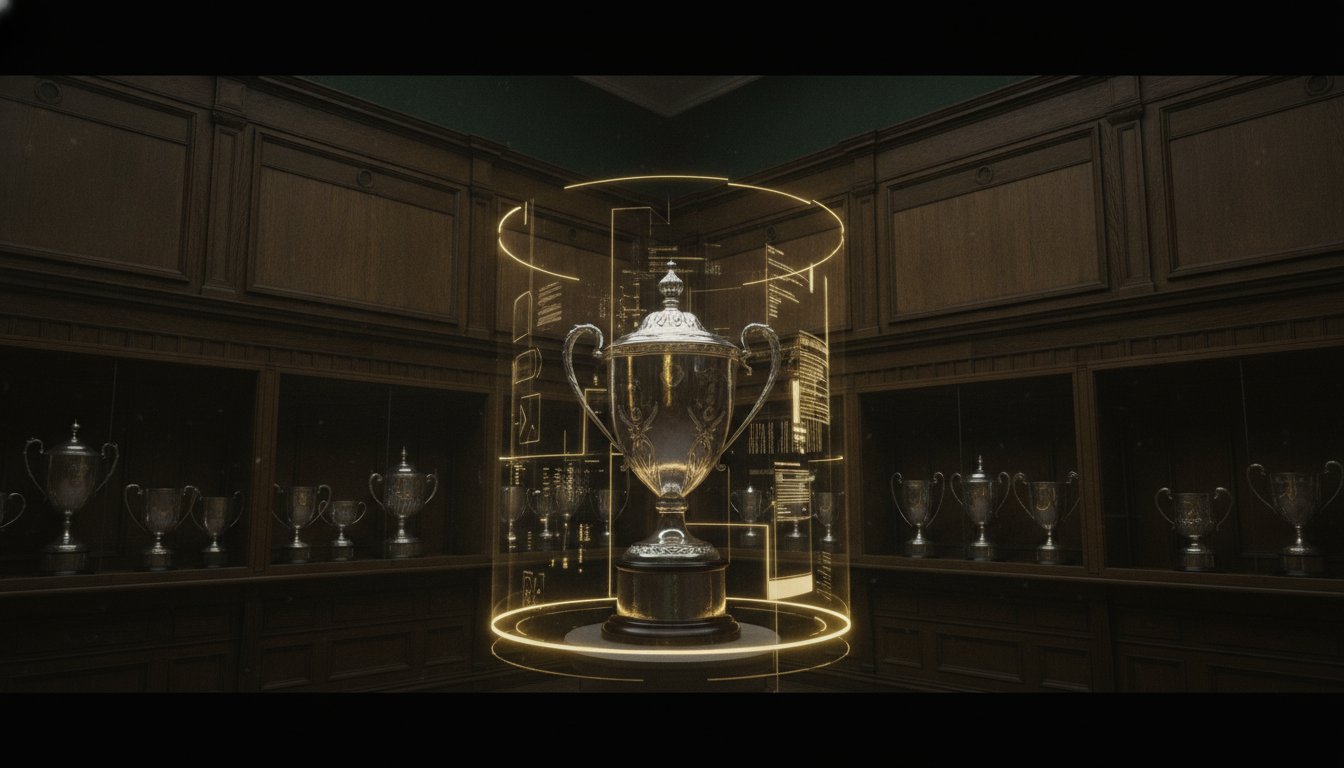
What if the decades of history etched into your club's silverware vanished tomorrow? It's a sobering thought for any guardian of local tradition. You likely value the heritage of your organisation, yet you know those names on the honours boards are trapped in a format that's impossible to search and fragile to maintain. Manual data entry is often the only alternative; however, it's a slow process prone to errors that few volunteers have the patience to complete.
We understand that preserving your legacy shouldn't feel like a chore. Our AI-powered trophy engraving transcription service offers a sophisticated way to bridge the gap between physical tradition and digital utility. By using advanced technology to read and record your trophies, we help you create a secure archive that's accessible to every member. In this article, you'll discover how to convert your physical records into exportable CSV files and launch a modern, online honours board. It's time to move from physical clutter to digital order and ensure your club's history is never forgotten.
Key Takeaways
- Learn how to protect your club's heritage by converting fragile physical trophies into a searchable, secure digital archive.
- Discover how AI-powered OCR technology overcomes challenges like curved surfaces and script fonts to ensure high transcription accuracy.
- Compare the efficiency of an automated trophy engraving transcription service against manual data entry to save weeks of volunteer time.
- Follow our best practices for inventorying your collection and capturing high-quality photographs to streamline the digitisation process.
- Explore how to engage your community with a modern digital honours board while maintaining data portability with exportable CSV records.
Table of Contents
What is a Trophy Engraving Transcription Service?
A trophy engraving transcription service is a specialized digital solution designed to rescue historical records from the surfaces of physical awards. It involves the methodical extraction of text-names, dates, and honours-from photographs of trophies, medals, and plaques. This process converts static inscriptions into a dynamic, searchable digital format. Instead of squinting at tarnished silver in a locked cabinet, club administrators can manage their entire heritage through a structured database.
The transition from physical plaques to a digital archive is a significant leap for any organisation. Traditional records are often trapped on honours boards or in dusty ledgers. These formats are difficult to search and impossible to share with a wider audience. By adopting a modern transcription approach, clubs move their history into the 21st century. This shift ensures that every achievement, from a 1920s cricket captaincy to last year's junior prize, is preserved with absolute clarity.
Data integrity is the cornerstone of this service. For schools and sports clubs, these records represent their identity. Unlike manual record-keeping, which relies on the steady hand of a volunteer, AI-assisted archiving provides a consistent and verifiable record. It creates a "single source of truth" that remains accurate regardless of who is currently managing the club's affairs.
The Problem with Manual Data Entry
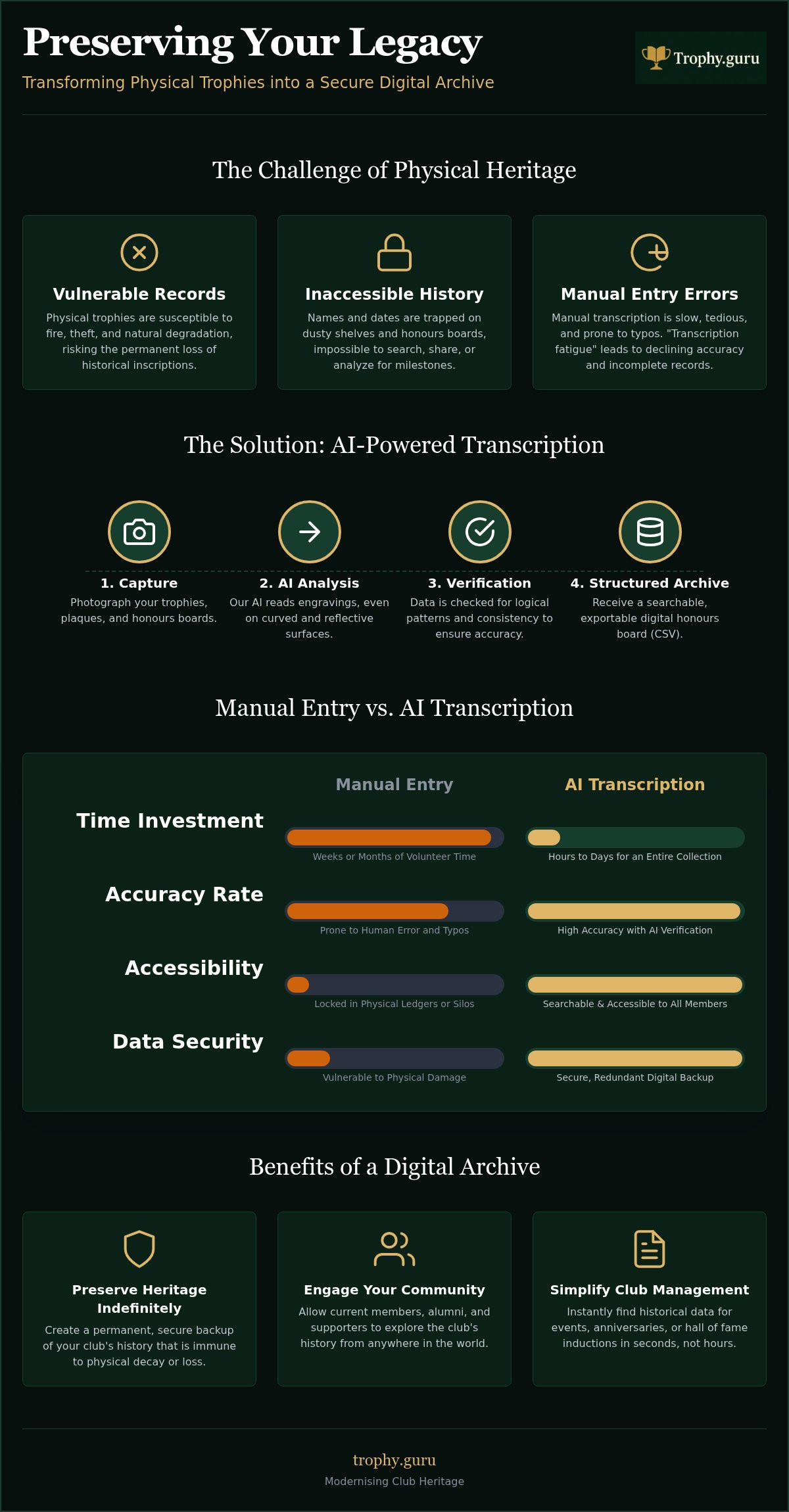
Typing out names from hundreds of trophies is a recipe for frustration. Manual transcription is notoriously prone to errors. A simple typo in a winner's surname can make that record invisible during a search. Volunteers often spend weeks squinting at curved, reflective surfaces, leading to "transcription fatigue" and declining accuracy. There's also the risk of "data silos." When records are kept in a single paper ledger or an offline spreadsheet on one person's laptop, the history is effectively hidden from the rest of the club. If that laptop fails or the ledger is misplaced, the heritage is gone.
The Role of Heritage Preservation
Physical awards are inherently vulnerable. Fire, theft, or even the natural tarnishing of metal can eventually render inscriptions illegible. Digitisation serves as a vital form of digital preservation, creating a secure backup that exists independently of the physical object. This accessibility adds immense value to the club community. Alumni and remote members can engage with the club's history from anywhere in the world. Having a searchable database also makes it much easier to celebrate milestones. Whether you're planning a centenary dinner or a hall of fame induction, you can find the necessary historical data in seconds rather than hours.
How AI-Powered Trophy Transcription Works
The process of converting physical inscriptions into digital text relies on specialised Optical Character Recognition (OCR). Standard OCR often fails on metallic surfaces because metal is reflective and frequently curved. Our trophy engraving transcription service uses vision-based models trained specifically to identify depth and contrast on engraved surfaces. These models look for the shadows cast within the letters rather than just colour differences. This is a key application of AI technologies in the cultural heritage sector, allowing us to recover data from objects that were previously considered unscannable.
Scripts and cursive fonts present another hurdle. Traditional software struggles with connected lettering. Modern AI uses context-aware algorithms to predict characters based on common names and historical naming conventions. Once the AI extracts the raw text, it passes through a verification layer. This step ensures that a 1994 isn't misread as 1991 due to a scratch on the silver. We check the results against logical patterns to maintain the highest level of accuracy.
Overcoming Reflective Surface Challenges
Glare is the primary enemy of clear transcription. Silver and gold trophies act like mirrors, often reflecting the photographer or the room. Our system applies high-contrast filters to the images to isolate the engraving from the background noise. By distinguishing between a deep engraving and a surface-level scratch, the algorithm ensures only the relevant historical data is captured. You can test this technology yourself with our free initial trophy transcription.
Structured Data and Metadata
Raw text is only useful if it is organised. We don't just provide a block of words; we convert the information into structured data. This means separating the Year, the Winner, and the Award Category into distinct fields. This structure is essential for building a searchable honours board. AI automatically categorises trophies within a collection, identifying which entries belong to the Captain's Cup or the Junior Merit. This metadata makes the records portable, allowing you to export them as CSV files for use in club management software or historical archives. When using a professional trophy engraving transcription service, the transition from raw image to structured database is seamless.
Manual Entry vs. AI Transcription: A Comparison
Choosing between manual entry and an automated trophy engraving transcription service is a choice between temporary fixes and permanent solutions. While manual recording might seem like a low-cost starting point, the logistical reality for most UK clubs is often overwhelming. Processing a collection of 100 trophies manually is a daunting task. A volunteer might spend 20 to 30 minutes per trophy to accurately record every winner across multiple shields, bases, and plinths. This quickly totals over 40 hours of meticulous work. AI handles this volume in a fraction of the time, allowing your committee to focus on member engagement rather than data entry.
Data portability is another critical differentiator. Manual records often end up in static paper ledgers or isolated spreadsheets that lack structure. These methods don't align with digital archiving best practices for long-term accessibility. AI transcription delivers structured CSV exports, making your data portable and ready for any future club management system. The ultimate advantage, however, is searchability. A digital archive allows you to find any name, year, or award in seconds. This transforms a dusty trophy cabinet into a functional historical resource.
Cost and Resource Allocation
Manual entry has significant "hidden costs." It relies heavily on volunteer goodwill, which is a finite and valuable resource. Projects that take weeks to complete often stall, leaving the archive half-finished. If errors occur during the typing process, the cost of auditing and fixing that data later is substantial. Our "Pay once" model for digitisation provides a clear, predictable line item for club budgets. It's a one-time investment that secures your heritage without the need for ongoing manual labour or recurring administrative headaches.
Accuracy and Verification
Human typo rates inevitably increase with fatigue. Squinting at reflective silver for hours leads to mistakes in surnames and dates. AI maintains a consistent level of precision throughout the entire collection. One of the most significant benefits of a professional service is the verification layer. We link the digital photo directly to the transcribed record. If there's ever a question about a specific name, you can view the original engraving with a single click. This ensures total consistency in spelling, even when inscriptions from the early 20th century are worn or faint. It provides a level of evidence that a simple spreadsheet can never match.
Best Practices for Archiving Your Trophy Collection
Archiving your club's history is a significant undertaking that requires a methodical approach. To ensure the best results from a trophy engraving transcription service, you should follow a structured five-step workflow. Start by gathering all physical items in one location. Grouping them by their respective categories, such as "Annual Awards" or "Special Commemorations," helps the AI understand the context of the collection. Second, capture high-quality photographs that serve as the source material for the AI. These images are the foundation of your digital archive.
Once you have your images, upload them to the transcription platform for processing. After the AI extracts the data, take a moment to review and verify the digital records against the original photos. While the technology is highly precise, a quick human check for unique local spellings or niche abbreviations adds a final layer of security. Finally, export your completed archive to a CSV file or publish it directly to a digital honours board to engage your members. This transition from physical clutter to digital order ensures your heritage is both searchable and secure.
Photographing Trophies for Transcription
Lighting is the most critical factor when photographing reflective metal. Avoid using a direct flash, as this creates "white-out" glare that obscures the engraving. Instead, use soft, indirect natural light or a diffused lamp. For curved surfaces like silver cups or bowls, position the camera to capture the most legible portion of the text in a single frame. If the engraving wraps around the base, take sequential photos to ensure every name is documented. A clear, high-contrast image significantly improves the speed and accuracy of the transcription process. Ensure the entire block of text is visible without distortion before moving to the next item.
Organising Your Digital Archive
Consistency is vital for long-term data management. Establish a clear naming convention for your image files before you begin the upload process. Grouping records by sport, house, or award type makes the final database much easier to navigate for alumni and current members. This structured approach prepares your data for seamless integration into your club's website or member portal. By organising your history now, you create a versatile resource that serves the club for decades. You can start your project today by using our free trophy transcription trial to see the results first-hand.
Modernising Your Club with Trophy Guru
Trophy Guru offers a streamlined path from physical archives to digital excellence. Our workflow is designed for total simplicity: Upload, Transcribe, Archive. By using our trophy engraving transcription service, you eliminate the administrative burden of manual record-keeping while ensuring every name is preserved with precision. This isn't just about data storage; it's about making your club's history a living part of its future. It's a transition from dusty cabinets to a dynamic digital presence.
We position our platform as the definitive solution for sports club record management across the UK. Whether you manage a historic cricket club or a modern school athletics department, our technology scales to meet your needs. We believe in the utility of our technology. This is why we offer a free trial to get your project moving. You can transcribe your first trophy at no cost to experience the accuracy and speed of our AI-assisted system first-hand. It's a low-risk way to begin your journey toward a more organised future.
The Searchable Digital Archive
A cloud-based digital honours board transforms how members interact with their heritage. Instead of squinting at tarnished plaques, members can instantly search for their own achievements or those of their ancestors. This interactive accessibility fosters a deeper connection to the club's legacy. It also allows committees to reduce physical clutter in the clubhouse without losing a single record. By moving your history online, you make it available to alumni worldwide. This creates a global community around your club's past successes and ensures every winner is recognised.
CSV Export and Data Security
We believe that your club should always own its data. Our system provides easy CSV exports, ensuring your records are portable and ready for use in other management tools. Cloud-based hosting provides a vital safety net, protecting your historical names from physical loss due to fire, theft, or environmental damage. Your archive remains secure, backed up, and ready for use at any time. As a dedicated trophy engraving transcription service, we prioritise the longevity and safety of your records above all else. To see how easy it is to safeguard your legacy, you can Start your first trophy transcription for free at Trophy Guru.
Secure Your Club’s Legacy for the Future
Digitising your honours boards and silverware is no longer a multi-week manual project for overburdened volunteers. By leveraging a professional trophy engraving transcription service, you move from fragile, reflective physical records to a secure and searchable digital archive. This transition ensures that every name and date is preserved against physical loss while making your history accessible to every member, regardless of where they are in the world. You've seen how AI overcomes the challenges of glare and curved surfaces to provide accuracy that manual entry simply can't match.
Your club's heritage is a living asset that deserves to be celebrated, not hidden away in a locked cabinet. With searchable digital archives and secure CSV data exports, you maintain total control over your records for decades to come. Try one trophy for free to see the clarity and precision of our workflow first-hand. It's time to bridge the gap between tradition and technology to ensure your organisation's history remains intact.
Preserve your club’s history with a free trophy transcription at Trophy Guru. Protecting your heritage is a noble task, and we're here to help you complete it with confidence and ease.
Frequently Asked Questions
How accurate is AI at reading old or worn trophy engravings?
The AI is highly effective at reading worn inscriptions by using high-contrast image processing to isolate shadows within the engraving. Unlike general OCR, our specialised system is trained on the reflective and textured surfaces common in heritage collections. If an inscription is particularly faint, our verification layer ensures logical patterns are checked. This methodical approach maintains high data integrity even for silver that hasn't been polished in decades.
Do I need to send my physical trophies to you for transcription?
You don't need to send any physical items to us. Our trophy engraving transcription service is entirely digital and operates nationally across the UK. You simply capture high-quality photographs of your trophies or honours boards and upload them to our secure platform. This eliminates the risk of damage or loss during transit and allows you to keep your valuable silverware safely in the clubhouse throughout the process.
What file formats can I export my transcribed trophy data into?
You can export your transcribed data into a structured CSV file at any time. This format is widely compatible with spreadsheet software like Microsoft Excel and Google Sheets, as well as most club management systems. By providing exportable data, we ensure you have total ownership and portability of your records. This prevents your club's history from being trapped in a proprietary system or a single physical ledger.
Can the service handle handwritten result sheets or just engravings?
Our system is designed to process photographs of both engraved surfaces and physical documents, including handwritten result sheets. The AI identifies text patterns across various mediums, from wooden honours boards to paper archives. This versatility allows you to consolidate all your historical records into one searchable database. It's an ideal way to digitise paper-based heritage that might otherwise be lost to environmental damage or misplacement.
How should I photograph a round trophy to ensure all names are captured?
To capture all names on a curved surface, you should take a series of sequential, overlapping photographs. Start at a fixed point and rotate the trophy slightly for each shot, ensuring each new frame shares a small portion of text with the previous one. Use soft, indirect light to minimise reflections on the metal. This methodical approach allows our system to reconstruct the full list of winners without missing any details.
Is there a limit to how many trophies I can transcribe at once?
There is no upper limit to the number of trophies or records you can transcribe at once. Our platform is built to handle everything from a single commemorative cup to the expansive archives of century-old sports clubs. We use a "Pay once" model for digitisation, which makes it easy for committees to budget for large-scale projects. You can start with our free trial to process your first trophy before committing to the full collection.
What happens if the AI makes a mistake with a specific name?
We include a robust verification layer where you can review and edit every transcribed record. Each entry in your digital archive is directly linked to the original photograph, allowing you to double-check any specific name with a single click. If the AI misinterprets a unique local spelling, you can correct it instantly in the dashboard. This ensures your final honours board is a 100% accurate reflection of your club's history.
Can I use the transcribed data for my club’s own website?
You can absolutely use the transcribed data to enhance your own club website. By using the CSV export feature, you can import the structured list of winners into your existing site's database. Alternatively, we offer digital honours board hosting that you can link to or embed. This interactive feature engages your members and alumni by making the club's heritage searchable and accessible from any modern device.
Frequently asked questions
How accurate is AI at reading old or worn trophy engravings?
The AI is highly effective at reading worn inscriptions by using high-contrast image processing to isolate shadows within the engraving. Unlike general OCR, our specialised system is trained on the reflective and textured surfaces common in heritage collections. If an inscription is particularly faint, our verification layer ensures logical patterns are checked. This methodical approach maintains high data integrity even for silver that hasn't been polished in decades.
Do I need to send my physical trophies to you for transcription?
You don't need to send any physical items to us. Our trophy engraving transcription service is entirely digital and operates nationally across the UK. You simply capture high-quality photographs of your trophies or honours boards and upload them to our secure platform. This eliminates the risk of damage or loss during transit and allows you to keep your valuable silverware safely in the clubhouse throughout the process.
What file formats can I export my transcribed trophy data into?
You can export your transcribed data into a structured CSV file at any time. This format is widely compatible with spreadsheet software like Microsoft Excel and Google Sheets, as well as most club management systems. By providing exportable data, we ensure you have total ownership and portability of your records. This prevents your club's history from being trapped in a proprietary system or a single physical ledger.
Can the service handle handwritten result sheets or just engravings?
Our system is designed to process photographs of both engraved surfaces and physical documents, including handwritten result sheets. The AI identifies text patterns across various mediums, from wooden honours boards to paper archives. This versatility allows you to consolidate all your historical records into one searchable database. It's an ideal way to digitise paper-based heritage that might otherwise be lost to environmental damage or misplacement.
How should I photograph a round trophy to ensure all names are captured?
To capture all names on a curved surface, you should take a series of sequential, overlapping photographs. Start at a fixed point and rotate the trophy slightly for each shot, ensuring each new frame shares a small portion of text with the previous one. Use soft, indirect light to minimise reflections on the metal. This methodical approach allows our system to reconstruct the full list of winners without missing any details.
Is there a limit to how many trophies I can transcribe at once?
There is no upper limit to the number of trophies or records you can transcribe at once. Our platform is built to handle everything from a single commemorative cup to the expansive archives of century-old sports clubs. We use a "Pay once" model for digitisation, which makes it easy for committees to budget for large-scale projects. You can start with our free trial to process your first trophy before committing to the full collection.
What happens if the AI makes a mistake with a specific name?
We include a robust verification layer where you can review and edit every transcribed record. Each entry in your digital archive is directly linked to the original photograph, allowing you to double-check any specific name with a single click. If the AI misinterprets a unique local spelling, you can correct it instantly in the dashboard. This ensures your final honours board is a 100% accurate reflection of your club's history.
Can I use the transcribed data for my club’s own website?
You can absolutely use the transcribed data to enhance your own club website. By using the CSV export feature, you can import the structured list of winners into your existing site's database. Alternatively, we offer digital honours board hosting that you can link to or embed. This interactive feature engages your members and alumni by making the club's heritage searchable and accessible from any modern device.