
Imagine sitting in your club committee room, staring at a cabinet of silver trophies that hold a century of hard-won victories, yet feeling only the weight of the hours it'll take to type every name into a spreadsheet. It's a daunting task that often leads to errors, typos, and the eventual loss of precious details. You likely know that preserving this history is vital, but the physical reality of managing reflective surfaces and worn metal makes manual recording feel like an endless chore.
We understand that your club's heritage is its soul, and it deserves better than being tucked away in a dusty cabinet or an error-prone file. By 2026, the transition from physical clutter to digital order has become simpler than ever. Through the use of AI-powered automatic trophy data entry, you can now eliminate the tedium of manual typing and achieve digital precision. This article explores how to build a searchable digital archive and export your records to CSV, ensuring your institution's history remains safe, accessible, and perfectly preserved for the next generation of members.
Key Takeaways
- Identify why manual typing often prevents clubs from archiving their history and how automation provides a practical solution.
- Explore the three-step process of automatic trophy data entry to turn physical engravings into precise digital records.
- Compare the speed and accuracy of AI-driven transcription against manual entry to save your committee valuable time.
- Learn how to optimise your environment for photography to capture clear data from curved or highly reflective trophy surfaces.
- See how a searchable digital legacy and CSV exports can protect your institution’s records for decades to come.
Table of Contents
- The Evolution of Record Keeping: From Engravings to Automatic Data Entry
- How Automatic Trophy Data Entry Works: A Technical Overview
- Manual vs. AI-Powered Transcription: A Comparative Analysis
- Preparing Your Collection for Automated Processing
- The Result: A Searchable Digital Legacy with Trophy Guru
The Evolution of Record Keeping: From Engravings to Automatic Data Entry
For generations, UK sports clubs and schools have relied on silver cups and wooden honours boards to tell their story. These items represent the pulse of a community, yet their data remains locked in physical form, hidden behind glass or stored in dusty cupboards. Looking back at the history of data entry, we see a clear shift from manual transcription to digital automation. This transition is now vital for preserving club heritage before physical records fade away.
In 2026, institutions are increasingly adopting automatic trophy data entry to bridge the gap between their physical past and a digital future. This technology isn't just about scanning names; it's the intersection of heritage-focused AI and modern data management. It allows clubs to move from physical storage, which is vulnerable to fire or loss, to digital accessibility. Making these records searchable ensures that a member's achievement from 1954 is just as discoverable as a win from last week.
The Limitations of Traditional Transcription
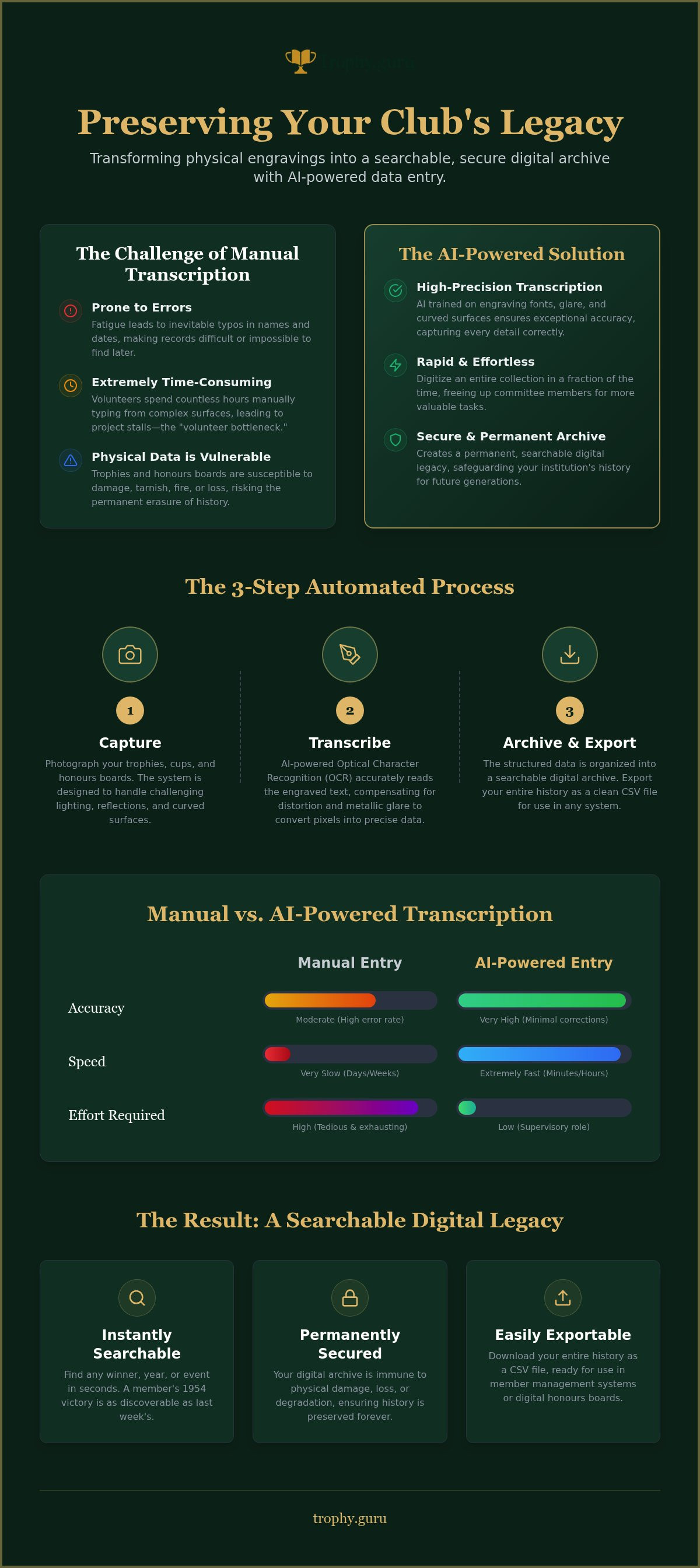
Manual data entry is the primary barrier to preservation. It's a slow, exhausting process that relies on volunteers who already have limited time. When a person spends hours typing names from a curved, reflective trophy, fatigue sets in and errors are inevitable. Small typos in a surname or a year can make a record impossible to find later. We often see the "volunteer bottleneck," where a digitisation project starts with enthusiasm but stalls after the first few trophies because the work is simply too tedious. Furthermore, the physical degradation of old engravings adds urgency. If these records aren't digitised now, the history they carry may eventually become unreadable due to tarnish or wear.
How AI Bridges the Gap for Heritage Collections
Standard OCR software often fails when faced with 3D objects. It struggles with metallic reflections, curved surfaces, and the specific serif fonts used by traditional engravers. Specialized automatic trophy data entry uses computer vision trained specifically for these challenges. It doesn't just read text; it interprets it within the context of a heritage collection.
- Precision: The AI handles metallic glare and distorted text on rounded surfaces with high accuracy.
- Searchability: The system generates structured metadata for every entry, making names and dates instantly searchable.
- Organisation: It organises raw data into clean CSV files, ready for member management systems or digital honours boards.
By 2026, "automatic" means more than just scanning. It means a methodical transition from physical clutter to a structured digital legacy that is safe, permanent, and easy to share with the whole club community.
How Automatic Trophy Data Entry Works: A Technical Overview
Moving from a physical trophy cabinet to a digital database requires a structured, three-stage workflow. This process, consisting of Capture, Transcribe, and Archive, ensures that every name engraved in metal is accurately preserved in code. By 2026, the technology behind automatic trophy data entry has matured to handle the specific environmental challenges found in clubhouses, such as low lighting and high-gloss surfaces.
The core of this system relies on sophisticated Optical Character Recognition (OCR). However, standard OCR often fails when faced with the reflective nature of polished silver or the curvature of a traditional loving cup. Modern computer vision solves this by using a verification layer. This layer identifies the shape of the object and compensates for distortion, ensuring that years and names are read correctly even when the text wraps around a cylindrical surface. You can see this technology in action by trying a free initial trophy transcription for your club's most challenging piece.
From Pixels to Text: The Transcription Engine
The transcription engine begins by mapping the physical layout of the award. For a wooden honours board, the AI identifies the grid-like structure of plaques and rows. For silverware, it must navigate the "mirror effect" where reflections can mimic the appearance of text. The system is trained on historical engraving styles, from traditional serif fonts to more ornate script. This allows it to distinguish between a decorative flourish and a legitimate character, reducing the need for manual corrections. Once the image is processed, the system converts the visual data into editable text strings while maintaining the chronological order of the winners.
Data Structuring and CSV Formatting
Raw text is only useful if it is organised. The AI automatically categorises the extracted information into distinct fields: 'Year', 'Winner Name', and 'Award Category'. This structured approach is essential for club administration; it allows for easy sorting and filtering. Once the transcription is complete, the data is prepared for a CSV archive export. This format is the universal standard for modern databases, ensuring your records are compatible with digital honours boards or member management software. By 2026, these exports have become the standard way for UK clubs to ensure their heritage is both safe and searchable, moving away from fragmented spreadsheets toward professional archival standards.
Manual vs. AI-Powered Transcription: A Comparative Analysis
Comparing the two methods reveals a stark contrast in efficiency. A dedicated volunteer might spend three weeks transcribing 100 trophies, factoring in the time to clean the metal, find the right light, and type every name. In contrast, automatic trophy data entry processes that same volume in minutes. This speed isn't just about convenience; it's about viability. Many digitisation projects fail because the manual workload is simply too high for a small committee to sustain.
Accuracy benchmarks also favour automation. Human fatigue is a significant factor in long-form data entry. After thirty minutes of reading tiny, serif engravings on a curved silver bowl, the eyes strain. Typos become frequent. AI algorithms maintain a consistent level of precision regardless of the batch size. They don't get bored or tired. This consistency is vital for schools and non-profit sports clubs that need reliable records but lack the budget for professional manual archivists. Moving your records to cloud-based archives ensures they remain accessible, whereas paper ledgers are vulnerable to loss, fire, or simple misplacement.
The Hidden Costs of 'Free' Manual Entry
The idea that manual entry is "free" because it uses volunteers is a common misconception. You must quantify the hours lost that could've been spent on coaching, fundraising, or community outreach. There's also the financial cost of correcting errors later. If a mistake is only found after an honours board is printed or a digital archive is published, the cost to rectify it is significant. Project abandonment is perhaps the highest cost. When a volunteer stops halfway through, the club is left with an incomplete, useless record that often sits untouched for another decade.
Scalability for Large Institutional Archives
Institutions with decades of history require a system that scales. Handling a single batch of 500 records is impossible for a small committee but routine for a transcription engine. This approach allows for Digital Cultural Heritage Preservation by standardising data across varying trophy types. Whether it's a 1920s silver cup or a 2026 acrylic plaque, the data remains uniform. Cloud-based archives ensure these records remain accessible for the next 50 years. Future-proofing your records today ensures the names of your current champions aren't forgotten by the next generation of members.
Preparing Your Collection for Automated Processing
The success of automatic trophy data entry depends heavily on the quality of the visual data provided to the AI. While the transcription engine is resilient, it performs best when it receives clear, high-contrast images that minimise the natural distortions of metallic surfaces. In 2026, UK clubs are finding that a methodical approach to photography saves significant time during the processing phase. It's the difference between a seamless archive and one that requires manual oversight.
Lighting is your most critical factor. Polished silver and gold-plated awards act like mirrors, reflecting the room and the photographer rather than the engraving. To avoid this, you should use indirect, diffused light. Position your trophies away from direct sunlight or harsh overhead bulbs. If you're working in a clubhouse with limited options, a simple white sheet used as a backdrop and light diffuser can eliminate the glare that often blinds standard systems. This ensures the AI can see the depth of the engraving rather than the reflection of the ceiling.
Photography Best Practices for Reflective Surfaces
To capture the full curve of an engraving on a silver bowl, angle is everything. Don't photograph the trophy straight on if the surface is highly cylindrical. Instead, take multiple overlapping shots from slightly different angles. This ensures the AI can reconstruct the text without losing characters to the edges of the frame. For more detailed guidance, read our guide on How to Photograph Trophies for Accurate AI Transcription. Maintaining a consistent distance from the object also helps the system calibrate the text size across your entire collection, ensuring uniformity in the final digital record.
Organising Your Digital Uploads
Organisation starts before you hit the upload button. Grouping your trophies by award category or era makes the final archive much easier to navigate. Use clear naming conventions for your files, such as "First_XI_Cricket_1950_1970.jpg". This metadata helps the AI categorise the data accurately during the extraction phase. When dealing with large honours boards, ensure the camera is perfectly parallel to the board to prevent distortion. Batching your records into logical sets allows for more efficient processing and easier quality control. Once you've prepared your images, you can upload your first trophy for free to see the precision of the results instantly.
Before submitting your batch, perform a quick visual check. If you can't read the name on your phone screen, the AI might struggle too. A few seconds spent retaking a blurry photo prevents delays later. This structured preparation ensures that your club's heritage is captured with the digital precision it deserves.
The Result: A Searchable Digital Legacy with Trophy Guru
The final transition from physical metal to a digital record is where the true value of your heritage is unlocked. By 2026, automatic trophy data entry has evolved from a simple administrative tool into a platform for community engagement. Once your transcription is complete, you aren't just left with a static spreadsheet. You possess a searchable sports club winner database that brings your history to life. This digital legacy serves as a bridge between generations. It allows younger members to see the path paved by those before them. Simultaneously, it gives alumni a powerful reason to reconnect with their old club.
For a deeper look at how this transformation works, explore our AI Trophy Engraving Transcription Service: Modernise Your Club Heritage. This service ensures that the transition from silver to screen is handled with the reverence your history deserves.
The Digital Honours Board Experience
Modern clubhouses often face a shortage of wall space as they expand their facilities or move to contemporary buildings. Digital honours boards solve this by condensing decades of history into a single interactive display. Members can search for their own names, filter by year, or browse specific award categories. This accessibility turns a static list of names into an interactive member experience. Whether displayed on a large touchscreen in the bar or embedded on your club's website, these records become a vital talking point. They ensure that every victory, no matter how old, remains visible and celebrated. It's about bringing the achievements of the past into the daily life of the current membership.
Managing Your Archive with CSV Exports
Maintaining the integrity of club records is often difficult during institutional handovers. When a long-standing secretary or archivist retires, paper records or fragmented files can easily go missing. Using CSV archive exports ensures your data remains in a universal format that any successor can manage with ease. You can easily import these files into Excel or dedicated club management software to track historical trends or verify past winners. This structured approach prevents data loss. It guarantees that your records are ready for any future technology. It's a permanent, safe, and professional way to manage your institution's story.
The transition from physical clutter to digital order is a noble task. It protects the legacy of those who competed before and sets a standard for those who will compete in the future. Ready to begin? You can start your first trophy transcription for free and see how easy it is to preserve your club's story with modern precision.
Securing Your Club’s History for the Next Century
The weight of a club's history shouldn't rest on the shoulders of a single volunteer with a spreadsheet. Transitioning to a digital archive is no longer a multi-week manual chore; it's a strategic move that preserves every name and date with absolute precision. By adopting automatic trophy data entry, you ensure that your institution's heritage is safe from physical degradation and administrative loss.
We've explored how modern AI handles the challenges of curved silver and reflective surfaces, turning raw images into structured, searchable data. This process creates a permanent record that engages alumni and inspires current members through an interactive digital honours board. It’s about more than just data; it’s about making sure the achievements of the past remain a visible part of your club's future.
Take the first step toward a modern, organised heritage today. You can digitise your first trophy for free with Trophy Guru. This offer allows you to try one trophy free, access your searchable digital archive, and export to CSV at any time. Your club’s story is worth protecting.
Frequently Asked Questions
How accurate is automatic trophy data entry for old engravings?
Automatic trophy data entry is highly precise, even for ornate historical engravings. Our AI is trained on thousands of traditional serif and script fonts commonly used by UK engravers over the last century. While tarnish and damage can affect readability, the system consistently outperforms manual transcription by removing the element of human fatigue. It's designed to recognise the depth and shadow of an engraving rather than just superficial markings on the metal.
Can the AI read names from curved silver trophies?
Yes, the system uses advanced computer vision to compensate for the curvature of silver bowls and cylindrical cups. It maps the 3D surface of the object to flatten the text visually before transcription begins. This allows the AI to read names that wrap around the trophy without losing characters at the edges. You don't need to worry about the "mirror effect" of polished silver, as the technology filters out metallic reflections.
What file formats can I export my trophy data into?
You can export your transcribed records into a standard CSV format at any time. This file type is universally compatible with Microsoft Excel, Google Sheets, and most modern club management or database software. Having your data in a portable CSV file ensures that your club’s heritage isn't locked into a single platform. It provides a flexible foundation for creating printed honours boards or digital archives that can be shared with your entire membership.
Is there a limit to how many trophies I can process at once?
There is no upper limit to the number of trophies you can process through our platform. Whether you have a single silver cup or a massive collection spanning multiple decades, the system is built to scale with your institutional needs. We offer tiered packages specifically for large collections, allowing you to upload and transcribe hundreds of items in a single batch. This makes it a practical solution for schools or established sports clubs with extensive archives.
Do I need professional photography equipment to use this service?
You don't need professional cameras or studio lighting to get accurate results. A modern smartphone with a decent camera is perfectly sufficient for capturing the images required for automatic trophy data entry. The key is to follow basic photography principles, such as using indirect light to avoid glare and ensuring the text is in sharp focus. We provide guidance on how to capture AI-ready photos using the tools you already have in your pocket.
How does the system handle names that are partially worn or faded?
The AI uses contextual logic to interpret names that are partially unreadable due to wear or fading. By cross-referencing dates and surviving characters, the system can often suggest the most likely transcription. If a name is completely obliterated by physical damage, the system flags the entry for your review. This hybrid approach ensures that your digital archive remains as complete as possible while maintaining the historical integrity of the record.
Can I edit the data once the AI has finished transcribing it?
You have full control over your data and can edit any entry once the AI has finished the transcription process. While the system provides high levels of accuracy, we understand that local knowledge is often vital for verifying specific historical details or unusual spellings. You can log into your digital archive to correct typos, add missing names, or update award categories. These changes are saved instantly to your permanent record and reflected in your CSV exports.
Is my club's historical data kept secure and private?
Your club's historical data is kept entirely secure and private within our hosted platform. We use industry-standard encryption to protect your records, ensuring that only authorised committee members can access or export the data. In 2026, maintaining digital security is a priority for heritage organisations. We ensure that your archive is backed up regularly and hosted on secure servers, providing a safe alternative to storing irreplaceable physical ledgers or fragmented local files.
Frequently asked questions
How accurate is automatic trophy data entry for old engravings?
Automatic trophy data entry is highly precise, even for ornate historical engravings. Our AI is trained on thousands of traditional serif and script fonts commonly used by UK engravers over the last century. While tarnish and damage can affect readability, the system consistently outperforms manual transcription by removing the element of human fatigue. It's designed to recognise the depth and shadow of an engraving rather than just superficial markings on the metal.
Can the AI read names from curved silver trophies?
Yes, the system uses advanced computer vision to compensate for the curvature of silver bowls and cylindrical cups. It maps the 3D surface of the object to flatten the text visually before transcription begins. This allows the AI to read names that wrap around the trophy without losing characters at the edges. You don't need to worry about the "mirror effect" of polished silver, as the technology filters out metallic reflections.
What file formats can I export my trophy data into?
You can export your transcribed records into a standard CSV format at any time. This file type is universally compatible with Microsoft Excel, Google Sheets, and most modern club management or database software. Having your data in a portable CSV file ensures that your club’s heritage isn't locked into a single platform. It provides a flexible foundation for creating printed honours boards or digital archives that can be shared with your entire membership.
Is there a limit to how many trophies I can process at once?
There is no upper limit to the number of trophies you can process through our platform. Whether you have a single silver cup or a massive collection spanning multiple decades, the system is built to scale with your institutional needs. We offer tiered packages specifically for large collections, allowing you to upload and transcribe hundreds of items in a single batch. This makes it a practical solution for schools or established sports clubs with extensive archives.
Do I need professional photography equipment to use this service?
You don't need professional cameras or studio lighting to get accurate results. A modern smartphone with a decent camera is perfectly sufficient for capturing the images required for automatic trophy data entry. The key is to follow basic photography principles, such as using indirect light to avoid glare and ensuring the text is in sharp focus. We provide guidance on how to capture AI-ready photos using the tools you already have in your pocket.
How does the system handle names that are partially worn or faded?
The AI uses contextual logic to interpret names that are partially unreadable due to wear or fading. By cross-referencing dates and surviving characters, the system can often suggest the most likely transcription. If a name is completely obliterated by physical damage, the system flags the entry for your review. This hybrid approach ensures that your digital archive remains as complete as possible while maintaining the historical integrity of the record.
Can I edit the data once the AI has finished transcribing it?
You have full control over your data and can edit any entry once the AI has finished the transcription process. While the system provides high levels of accuracy, we understand that local knowledge is often vital for verifying specific historical details or unusual spellings. You can log into your digital archive to correct typos, add missing names, or update award categories. These changes are saved instantly to your permanent record and reflected in your CSV exports.
Is my club's historical data kept secure and private?
Your club's historical data is kept entirely secure and private within our hosted platform. We use industry-standard encryption to protect your records, ensuring that only authorised committee members can access or export the data. In 2026, maintaining digital security is a priority for heritage organisations. We ensure that your archive is backed up regularly and hosted on secure servers, providing a safe alternative to storing irreplaceable physical ledgers or fragmented local files.