What if every name engraved on a school trophy could be found in seconds, without opening a cabinet or searching through old paperwork? Those records capture years of achievement, but fading inscriptions, limited display space and hours of manual data entry can make them difficult to preserve and share. To digitize school trophy records is to do more than create a display: it makes the history behind each award searchable and accessible.
This guide explains how to turn physical trophies, plaques and honours boards into an organised digital archive. You’ll learn how to plan the project, photograph inscriptions clearly, review transcriptions and structure the information so alumni, families and school communities can explore it.
AI-assisted transcription can help reduce repetitive data entry, while keeping source images makes it easier to verify names and dates later. A CSV export and searchable online honours board can make the archive useful over time. Trophy Guru offers a free initial trophy transcription, giving your school a practical way to start with one record and plan the next steps.
Key Takeaways
- Learn what it takes to digitize school trophy records so engraved achievements become structured information rather than names hidden on physical awards.
- See how AI-assisted transcription can turn trophy images into organised entries, while keeping the original details available for checking.
- Use a collection audit and considered photography setup to prepare trophies, shields and honours boards for digitisation.
- Compare manual typing with AI-assisted transcription to choose a workflow suited to the size and condition of your archive.
- See how portable data and a searchable online honours board can help keep school history accessible over time.
Table of Contents
Why Schools are Moving Beyond the Glass Trophy Case
A trophy can honour a remarkable achievement, but its engraving is difficult to find if you don’t know where to look. Names etched on silver or brass aren’t visible to search engines, and alumni may never see their place in the school’s history if they can’t visit the display in person.
Trophy record digitisation turns inscriptions into structured, searchable information, such as a recipient’s name, the year and the award. It’s one practical application of what is digitization: converting analogue material into a digital format so it can be accessed and preserved. To digitize school trophy records is to make achievements easier to discover, not simply to create another picture of a trophy.
The Limitations of Physical Recognition
Display space is finite. As new awards arrive, schools must decide what to show, move trophies into storage or find more room. A trophy case is also a static record: it can show an object and its engraving, but it can’t readily explain the people, teams or traditions behind them. When displays are spread across halls and buildings, keeping a complete record can be challenging.
Physical records are vulnerable, too. Tarnishing can make inscriptions harder to read, while theft, fire or other damage may remove the only surviving record of an achievement. A digital transcription preserves the information in another format, even if the original object later changes or becomes inaccessible.
The Digital Heritage Advantage
Organised data lets people search records by recipient, year or sporting house instead of scanning every trophy by eye. That turns a hidden list of names into a resource that alumni, families and current pupils can explore, helping them reconnect with shared school traditions.
A digital archive can also carry context beyond the cabinet. Records can be arranged to tell a story across generations, while an online honours board makes achievements accessible to people who aren’t on campus. Former recipients can find their names, and the school can share the history behind its awards with alumni and families.
Digital records remain accessible as the institution changes. Renovations may alter a reception area or relocate a collection, but an organised archive can continue to hold the information. The physical trophies still matter; a digital record means their stories aren’t confined to the glass around them.
The Technology Behind AI Trophy Transcription
Transcribing decades of awards by hand can become the bottleneck in an archive project. AI-assisted transcription helps with the repetitive first step: reading an inscription from an image and turning it into text that can be organised and searched. It supports careful record-keeping, but historical details still need to be reviewed.
How AI Reads Reflective Silverware
AI transcription for heritage preservation uses artificial intelligence to read inscriptions from images and convert them into searchable digital records. Traditional optical character recognition works best with clear, flat text. Trophy engravings pose a different challenge: lettering may curve around a cup or bowl, while reflections, shadows, worn marks and decorative fonts can obscure characters.
Computer vision can help locate text within an image, and AI models can interpret the lettering in context. The result may still need review, especially when a name or date is unclear. Treat a transcription as a carefully prepared draft, not unquestionable evidence.
From Photo to Structured Data
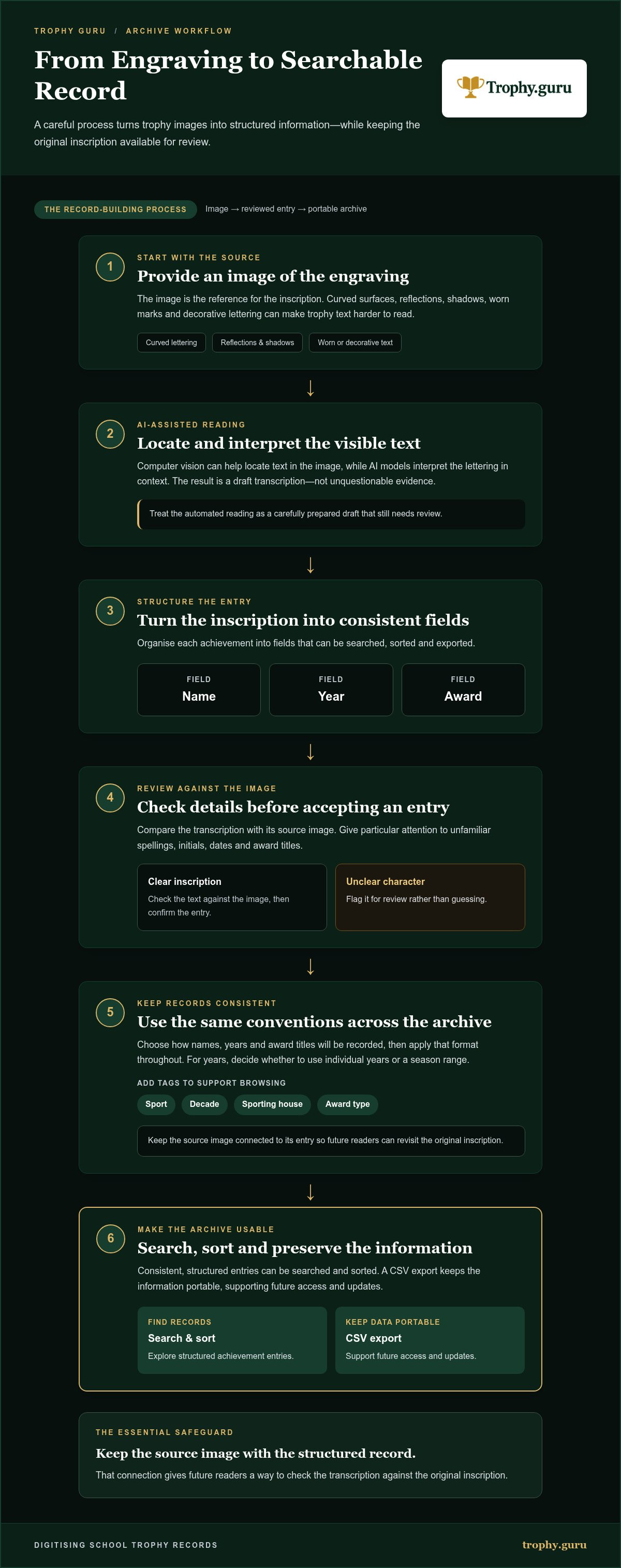
The process begins with an image of the engraving. AI-assisted tools analyse the visible text and can organise it into fields such as Name, Year and Award. Instead of leaving a long list of unstructured notes, each achievement becomes a consistent entry that can be searched, sorted and exported.
Before accepting an entry, compare the transcription with its source image. Check unfamiliar spellings, initials, dates and award titles. If a character isn’t clear, flag it for review rather than guessing. This review step helps catch errors automated reading may miss.
Consistency matters across a large archive. Decide how to record names, years and award titles, then use the same conventions throughout. For example, choose whether years are recorded individually or as a season range, and apply that format consistently. Keep the image connected to the entry so future readers can revisit the original inscription and understand the basis for the transcription.
Add useful details to help people explore the archive. Tags for sport, decade, sporting house or award type let users browse in different ways instead of relying only on a name search. A structured CSV export preserves information in a portable format, supporting future access and updates. These steps help digitize school trophy records without creating another hard-to-search list.
Schools can start with a sample: Trophy Guru offers one trophy transcription free. Explore AI trophy transcription to see how engraved records can become structured archive data.
Manual Data Entry vs. AI: Evaluating Your Approach
Typing every inscription by hand gives you direct control, but it can turn a heritage project into a long queue of repetitive tasks. A trophy may have a name, award title and date engraved on a curved or reflective surface, rather than printed neatly on a page. AI-assisted transcription can turn images into draft records, leaving people to check and organise the information.
The Hidden Costs of Manual Transcription
Manual entry takes more than typing time. Someone must inspect or photograph each inscription, enter the details, apply consistent formatting and review the result. In a school or alumni association, the work may fall to a small group of staff or volunteers. If their time is limited, progress can stall before the archive is complete.
Long projects also risk inconsistent records. One person might enter a full first name, while another uses an initial; award titles and date formats can vary as the work passes between people. Fatigue can lead to missed characters or typing errors. Clear rules and a shared review process help, but still require coordination and time.
Why AI Is the Modern Standard
AI can provide a scalable first pass when a school has a large collection to process. It can identify text in trophy images and place likely details into consistent fields, reducing repetitive data entry. That can help organise records gathered over many decades, although worn, ornate or reflective engravings may be misread. Review remains essential, especially for names and dates with historical significance.
Think of the workflow as a division of labour: AI handles initial text recognition and formatting; a person checks uncertain entries against the original image and resolves variations. This lets people focus on judgement and context rather than routine copying. For a closer look at the process, read about AI trophy engraving transcription services.
To digitize school trophy records efficiently, match the method to the size and condition of the collection. A small set of clear inscriptions may be manageable by hand, while a larger archive is more likely to benefit from AI-assisted transcription and a planned review stage. When comparing approaches, consider the time required for manual entry alongside the work needed to check AI-generated drafts. The right workflow depends on the collection and the time available to manage it.
Trophy Guru’s free initial trophy transcription gives schools a way to start with a sample before planning a wider archive. Use the first record to assess how the image, transcription and data fields fit your school’s review process.
Preparing Your School Records for Digitization
A little preparation makes transcription easier to manage and the resulting archive more consistent. Start with an inventory of trophies, shields and honours boards. Note their location, approximate date range and subject area. This list helps you group related records, spot gaps and decide what to photograph first. Focus on recording the inscriptions; avoid moving or treating objects unnecessarily.
Photography Tips for Reflective Surfaces
Set up a steady photography station with a plain, non-reflective background. Avoid direct flash, which can create glare on silver and glass and obscure engraved letters. Use soft, indirect natural light where possible, and position the camera square to the inscription. Curved cups may need several views: take overlapping photographs around the bowl so the lettering remains legible and no part disappears around the curve.
Test the setup on a trophy with faint or difficult lettering before photographing the full collection. Review the image at full size and adjust the light or camera angle if reflections wash out the inscription. Keep the original image with the transcription so you can check details later.
Organising the Workflow
Group objects into manageable batches, such as by era, department or award type. Arts and sports records, for example, can be photographed separately while following the same naming rules. Use a consistent file name that links each image to its object, such as Sports_1980s_AnnualCup_01. Don’t rely on a volunteer’s memory to explain what an image shows.
For a large honours board, photograph it section by section. Include enough overlap between frames to show how the sections connect, and label the files in reading order. This makes it easier to match names to the correct part of the board during transcription.
Decide which details matter before building the archive. A useful starting structure might include recipient name, award title, year, sport or activity, sporting house and source image. Keep field names and date formats consistent, and flag uncertain details for review instead of filling gaps with guesses. This preparation makes it easier to connect the records to a digital honours board.
Once you have an inventory, clear images and agreed data fields, you’re ready to digitize school trophy records in a controlled workflow. Start your trophy transcription with a free initial trophy transcription, then use the result to shape your school’s archive process.
From Digital Archive to Interactive Honours Board
A spreadsheet preserves information, but an honours board can make it part of school life again. A searchable resource lets pupils, families and former students explore achievements, follow sporting traditions and discover the people behind the awards. The board can be accessed online on everyday devices, and schools can also choose to share it through QR codes or a kiosk screen.
The Searchable Honours Board
Search gives alumni a simple way to find a name, year or award, wherever they are. Add context where it’s available, such as a team photograph or match report, so an entry tells more than who won. A familiar record can become a starting point for sharing memories and connecting generations of the school community.
Keep the board current by setting a routine for adding new achievements and correcting records when better information comes to light. Trophy Guru’s searchable digital honours board hosting gives schools a way to present transcribed records online rather than leaving them solely in a spreadsheet. Schools can also use the archive in alumni events or fundraising communications, bringing relevant achievements into reunion displays and stories about the community’s history.
Long-term Data Security
Plan for both access and preservation. A hosted archive can make records convenient to browse, while a separate local copy provides another way to retain the data. Neither approach alone is a complete preservation plan. Keep a current export, store copies securely, and make clear who is responsible for updates and access.
Data portability matters if a school changes systems or its needs evolve. Keep records in a usable format such as CSV, which can be opened in common spreadsheet software, and retain the images that support key transcriptions. An export helps the school maintain a separate copy of its archive and move information between tools without rebuilding every entry from scratch.
Before presenting the board, decide what readers should be able to search and what context they’ll need. Then plan regular updates and keep an independent copy of the data. When you digitize school trophy records with accessibility and portability in mind, the archive can serve alumni today and remain useful through future platform changes.
Give Your School’s Achievements a Lasting Digital Home
School trophies hold more than names and dates. They preserve the people, teams and traditions that shaped the community. Digitising their engravings turns hard-to-search inscriptions into organised records that alumni and families can explore.
A considered process makes the difference: prepare clear images, use AI-assisted transcription to reduce repetitive data entry, and review uncertain details against the original. Keep the archive useful with consistent records, regular updates and a portable CSV export. A searchable online honours board can help bring that history to life beyond the trophy cabinet.
Trophy Guru provides AI-powered trophy transcription and digital honours board hosting for schools and heritage collections across the UK. Start with a sample transcription, then build your archive from there. Digitise your first school trophy for free with Trophy Guru.
Every name recovered is another part of your school’s story made easier to find and preserve. Take the first step to digitize school trophy records, and give that legacy a future beyond the glass case.
Frequently Asked Questions
How long does it take to digitise an entire school trophy collection?
There’s no single timeframe: it depends on the number of trophies, the clarity of the engravings and how much review each record needs. A small collection of legible inscriptions takes less work than decades of awards with worn or reflective lettering. To digitize school trophy records methodically, begin with an inventory, photograph in organised batches and allow time to review names and dates.
Can AI accurately read very old or faint engravings on silver?
AI can help interpret old or faint inscriptions, but results depend on the image and the condition of the engraving. Reflections, worn lettering and ornate fonts can make characters difficult to distinguish. Photograph the inscription from more than one angle if needed, then compare the suggested transcription with the original image. Flag unclear names or dates for review rather than treating an uncertain reading as fact.
Do we need to send our trophies away for transcription?
No. Trophy Guru’s transcription process uses uploaded photographs, so the physical trophies can remain at school. Photograph each engraving clearly and upload the images for AI-assisted processing into searchable records. Keeping awards on site avoids moving objects that may be fragile or difficult to transport. Retain the source images with the resulting records so details can be checked later.
What is the best way to photograph curved trophies for AI?
Use soft, indirect light and avoid direct flash, which can create glare on silver and glass. Place the trophy against a plain background, hold the camera steady and frame the engraving clearly. Since text can curve out of view around a cup or bowl, take overlapping images from different angles. Review the photographs at full size before uploading, especially if letters look faint or obscured.
Can we export our school trophy records to Excel or CSV?
Yes. Trophy Guru provides a CSV archive export, which lets schools keep a portable copy of their records. CSV files can be opened in spreadsheet software such as Excel, where entries can be sorted or reviewed. Keep field names and date formats consistent, and retain the original photographs alongside the data. This makes it easier to verify transcriptions and use the archive in future workflows.
How do digital honours boards handle historical data from wooden boards?
Photograph the wooden board in sections, keeping the images in reading order and overlapping frames enough to show how the sections connect. Transcribe names, years and award details from those images, then organise the entries in consistent fields. If a name or date is unclear, flag it for review rather than guessing. Connecting each digital entry to its source image helps preserve context and supports later verification.
Is there a limit to how many names can be stored in a digital archive?
Storage capacity varies between digital archive platforms, so there isn’t one universal limit for every system. For a growing school collection, organise records by year, sport, house or award type, and keep a CSV export as a separate copy. This makes a large archive easier to manage and helps keep the information portable as the collection expands.
What happens to the data if we stop using a specific software provider?
Keep an independent copy of your records so they aren’t accessible only through one platform. Trophy Guru provides CSV export, giving schools a portable copy of the structured data. Save source photographs separately, too, since a spreadsheet may not contain the images that support each transcription. Before changing systems, organise and review your files so names, dates and award details can be transferred with their context.