
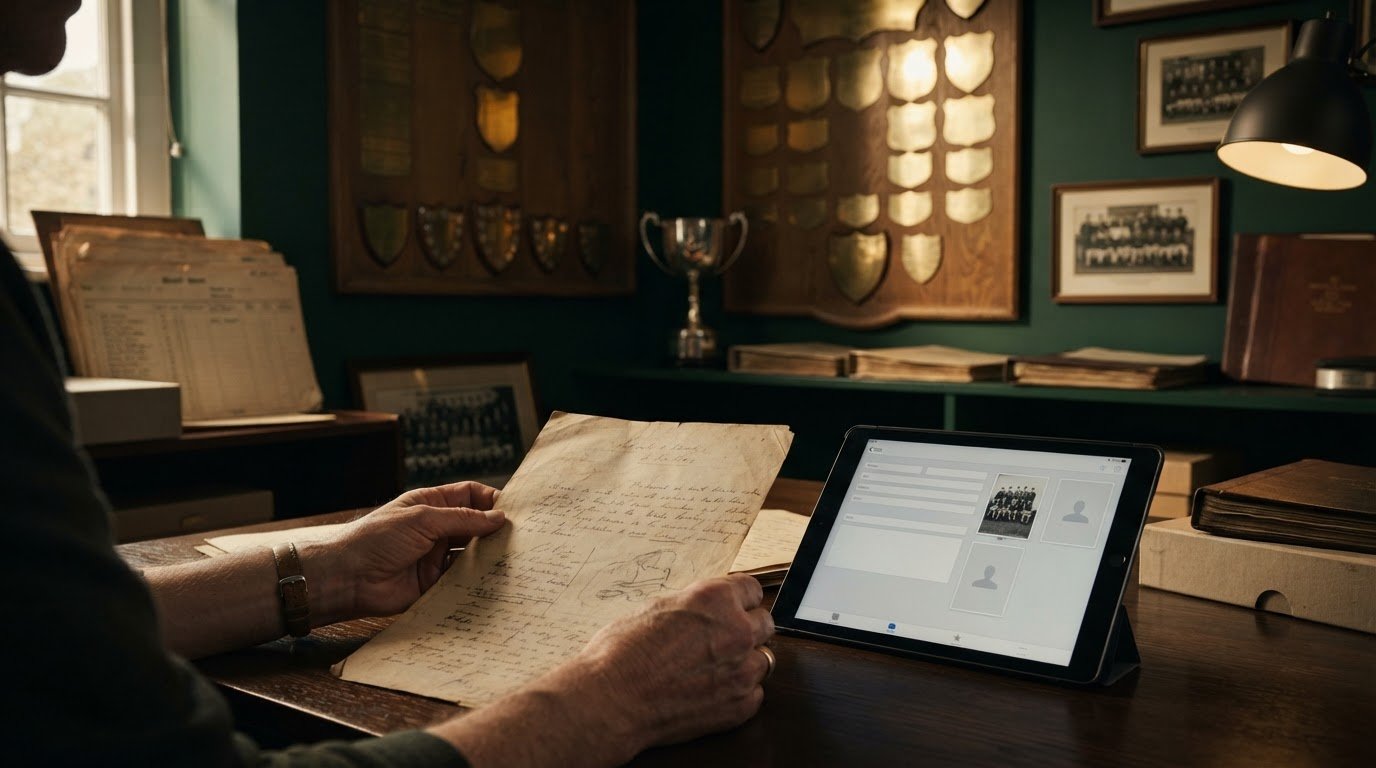
The best way to preserve club history online isn’t to start by choosing a platform. First, find out what your records say, where they came from and who can help verify them. A trophy engraving, an honours board and a result sheet may each tell part of the story, while a long-serving volunteer may remember details that were never written down.
The task can feel daunting when club history is scattered across physical records and personal collections. You don’t need to digitise everything at once, or treat every unconfirmed detail as fact. A clear plan helps your club prioritise important records, check names and dates, and preserve the context that makes each item meaningful.
This practical checklist explains how to collect and assess material, organise accurate digital records, and decide what to share publicly or keep for members. It also covers ways to make honours and results easier to search, including AI-assisted transcription, while keeping people involved in checking the details. The aim is an online record that future members can discover, understand and maintain.
Key Takeaways
- Start with an inventory that records what each item is, which period or event it relates to, and who can help interpret it.
- Prioritise unique, fragile or frequently requested records so digitisation begins where it can make the greatest difference.
- Choose a structure that suits how members look for information, then use consistent details such as names, dates and events to make records easier to browse.
- To preserve club history online, give each record a clear source and verification status, and decide who is responsible for corrections and handover.
- Review access decisions and archive details periodically. Searchable transcription and CSV export can help keep honours and results findable beyond the original physical record.
Table of Contents
- Why preserving club history online starts with the records you already have
- Build a reliable online club archive from physical records and memories
- Choose what to publish and how members should find club history
- Use this checklist to make club-history preservation manageable
- Keep club history searchable, exportable and ready for future members
Why preserving club history online starts with the records you already have
To preserve club history online, start with the evidence your club already holds, not with a new platform. Online preservation means creating organised, findable digital records that retain their context and have someone responsible for checking and maintaining them. Simply putting files on a website is not enough. Future members should be able to understand what each record shows and how reliable it is.
Different sources tell different parts of the story. A trophy engraving may record a winner and year; an honours board can show how an award continued across seasons. Result sheets provide event details, minutes can explain decisions, and photographs may capture people or moments that official records leave out. Together, they create a fuller account than any one source could provide.
That context matters in digital preservation, which concerns keeping digital information accessible and understandable over time. Digitising an item preserves a copy; preserving its historical meaning also means recording where it came from, what it shows and how confidently the details are known.
What counts as club history worth preserving?
Look beyond major trophies. Competition results, award recipients, milestone events and the stories behind them can all help explain how the club developed. For each record, capture known dates, names, event titles and source details, such as the relevant result sheet or board. Keep confirmed facts distinct from recollections that still need checking. A volunteer’s memory can be valuable evidence, but label it as a recollection until it is corroborated.
Physical records and personal knowledge can be vulnerable in different ways. Inscriptions may fade, paper files can be misplaced, and details held by one long-serving volunteer may not be written down elsewhere. Recording sources and uncertainty now gives later members a better chance of checking the story instead of inheriting an unqualified claim.
Why make club history available online?
Searchable records help members look up a name, season or achievement without needing to know which cupboard holds the relevant file. A digital honours board, for example, can make past recipients easier to find while the physical board remains part of the club’s surroundings. Online records should complement original objects, not replace them. Keep the object’s description and source alongside its digital entry.
Not every record needs to be publicly accessible. Some material may contain personal or sensitive information, so decide who should be able to view it before sharing. A clear access decision and an identified person responsible for the record help the archive remain useful and appropriately managed.
Build a reliable online club archive from physical records and memories
Before scanning or transcribing anything, create a simple inventory. It gives the club a view of what exists, where it is held and what needs attention. Volunteers can then work in a sensible order instead of trying to digitise everything at once.
Make a practical inventory before digitising
Group items by format, period, event and known custodian. Include trophies, plaques, honours boards, result sheets, photographs, programmes and minutes. A spreadsheet is enough to get started. For each item, record its description, approximate date or season, current location, source and the person who can provide context. Note any access restrictions too.
Flag items that need follow-up, such as unclear inscriptions, missing dates, damage, duplicate records or conflicting versions of a result. Then prioritise material that is unique, fragile or often requested. A trophy engraving that is difficult to read may need attention before an easily replaced programme. Use the inventory to agree what to handle first and what can remain safely where it is.
Capture context alongside names and dates
For each digital entry, record the award or event name, season, recipient and source wherever known. Link the entry to the original item’s location, such as a particular honours board or a named folder of minutes. That connection lets someone return to the evidence rather than treating a digital transcription as the only record.
Provenance turns an archive entry from an isolated claim into a traceable record: it shows where the information came from and who helped interpret it.
Preserve uncertainty rather than smoothing it away. If an engraved surname could be read in two ways, retain both spellings in a note and mark the reading as unconfirmed. Ask knowledgeable members to identify people, events or abbreviations, then record who confirmed the detail and what source they used. A recollection can add valuable context, but it should remain distinguishable from a fact supported by a contemporary record.
Where the club already has photographs of trophy engravings, honours boards or result sheets, AI-assisted transcription can help turn names, years and details into searchable entries. Treat the resulting text as a draft to check against the source, especially where an inscription is worn or a name is unusual. Trophy Guru offers AI-assisted trophy transcription, digital honours board hosting and CSV archive export. These tools can support a wider preservation plan, while each entry remains connected to the original item. A club can explore searchable honours records as one way to make selected entries easier to find.
Choose what to publish and how members should find club history
A well-organised archive reflects the way members look for information. Some want to browse a season, others remember a particular competition, and many search for a person’s name. You don’t have to choose only one route. Consistent record details can support several ways of finding the same entry.
Organise records so members can discover them
Consider a sample entry: Alex Morgan won the senior singles trophy at the 1998 summer tournament. A date-based archive places it under 1998. An event-based archive files it under the summer tournament or senior singles award. A person-based archive brings it up under Alex Morgan. Each structure suits a different browsing habit, so use clear categories and a predictable search method.
Record consistent fields wherever they apply, such as recipient, year, event, award and source. Tags or categories can connect entries across seasons, making it easier to follow a person’s achievements without duplicating records. Keep spelling and event names consistent, and note alternate forms where they’re historically relevant.
For clubs maintaining tabular records, CSV is a portable format for storing entries in rows and columns. Trophy Guru offers CSV archive export, which can help a club retain a copy of its archive data. Check what information the export contains and how it fits your club’s record-keeping process. Don’t assume a CSV file includes photographs or contextual notes unless confirmed.
For display-focused planning, see this guide to digital honours boards for sports clubs. A display can make selected achievements visible, while a well-structured archive supports broader searching and browsing.
Set sensible access and privacy boundaries
Decide the audience for each category before publishing. Public records might include established competition results or historic award recipients. Member-accessible material could include club documents intended for the membership, while restricted records may contain personal details that shouldn’t be widely shared. The right choice depends on the record and the club’s needs.
Before making personal information available, check the club’s policies and current privacy obligations. Set a straightforward route for members to report an error, disputed entry or inappropriate disclosure. Assign someone to review reports, check the available source and record any correction. This helps the archive remain discoverable without treating access as all-or-nothing.
To preserve club history online, plan both how members will find records and who should be able to view them. Clear fields make entries easier to locate; considered access decisions help ensure they’re shared appropriately.
Use this checklist to make club-history preservation manageable
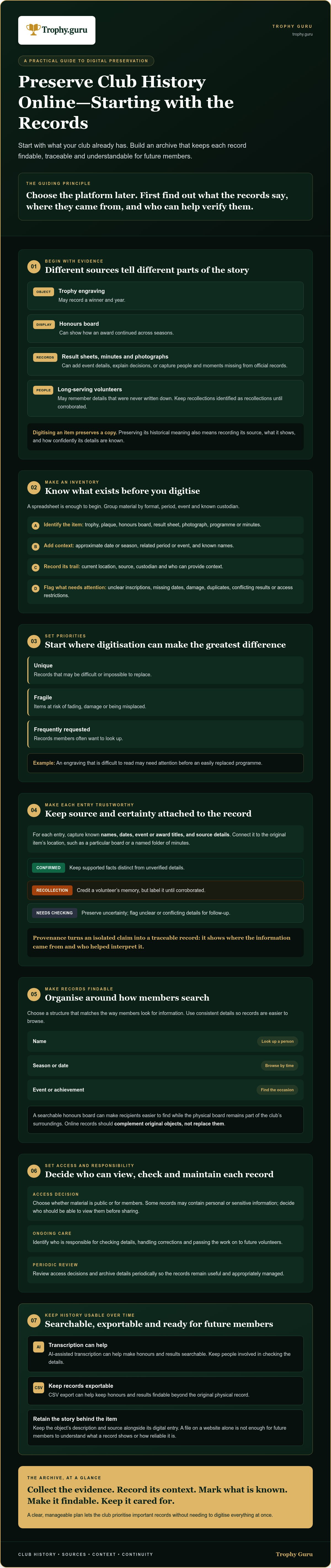
A committee doesn’t need to digitise its entire collection before members can benefit. Set a manageable scope, complete one useful group of records, then build on a process volunteers can repeat. Each stage below creates a practical output, so progress stays visible and the work can pause without losing its place.
A five-stage checklist for getting started
- Agree the scope. Appoint a coordinator and choose a manageable starting point, such as one award or a particular season. Output: a named coordinator and a short list of priority records.
- Inventory the material. Note what exists, where it is held and who can provide context. Mark fragile, unique, frequently requested or unclear items. Output: an inventory with priorities and follow-up notes.
- Capture selected sources. Make readable digital copies of priority items using a method suitable for the material, and keep track of each original’s location. Don’t move or handle delicate objects unnecessarily. Output: source copies linked to identified physical records.
- Transcribe and verify. Record names, dates, awards and events, then check each entry against its source. Ask a knowledgeable member to review uncertain readings and note who confirmed them. Output: verified entries, with unresolved details clearly flagged.
- Add context and decide access. Include the source and relevant notes, then decide whether each record is public, available to members or restricted. Output: contextualised records with a documented access decision.
This order keeps the immediate work focused: identify, capture, check and make a considered access choice. Improvements such as expanding to more seasons, refining categories or adding further collections can follow as time allows. For practical guidance on record capture, see this guide to digitising sports club award records.
Make the work sustainable for volunteers
To preserve club history online for the long term, assign responsibility for new entries, correction requests and periodic reviews. Write down simple conventions for names, dates, event titles and uncertainty notes. A shared reference helps the next volunteer continue the work without having to guess how earlier entries were handled.
Keep the routine small. Schedule a brief recurring review to check a batch of recent additions, resolve flagged details or update access decisions, rather than waiting for a large archive project. If trophy inscriptions are a priority, try the free initial trophy transcription as one practical step within the wider checklist.
Keep club history searchable, exportable and ready for future members
A digital archive needs more than accurate entries. It needs clear ownership, a routine for corrections and a handover that lets the next committee continue the work. Without these, records can become difficult to update or trust when volunteers move on.
Protect continuity when committee roles change
Keep a shared handover document that explains the archive’s purpose, field definitions, naming conventions and review responsibilities. Identify who can approve corrections, add new records and decide access. Include a route for members to submit corrections or historical context, and record how each report is checked and resolved.
Check that records can be exported in a usable format before committing to a workflow. An exportable archive gives the club a practical way to retain its data if its needs or tools change. Trophy Guru offers CSV archive export; check that the information provided suits your club’s record-keeping needs. Schedule periodic reviews of names, dates, links and access decisions so errors and outdated permissions don’t quietly persist.
Where AI-assisted trophy transcription can help
AI-assisted transcription can help turn photographs of trophy engravings, plaques, honours boards and result sheets into searchable digital records. It can make names, years and award details easier to find, but extracted text still needs human checking. Compare each entry with the source material before publication, particularly if an inscription is worn or a name is uncertain. Keep the source and any notes alongside the confirmed record.
For a closer look at this process, read the guide to AI trophy engraving transcription. Trophy Guru combines AI-assisted transcription with searchable digital honours board hosting and CSV export as part of a wider archive plan. Check current account, privacy, retention and sharing controls before deciding which records to publish through any platform.
To preserve club history online, build a routine that can survive committee changes: document how records are handled, review them regularly and make corrections traceable. A free initial trophy transcription can be a useful first step, but it is not a substitute for the club’s broader preservation plan.
Make your club’s history easier to carry forward
A dependable online archive starts with records the club can trace and trust. Take stock of what you hold, capture context alongside names and dates, and verify uncertain details before sharing them. Then choose a structure and access level members can use, with clear responsibility for corrections and future handovers.
You don’t have to digitise everything at once. A small, repeatable process can make important achievements easier to discover while keeping each digital entry connected to its physical source. That’s a practical way to preserve club history online for future members.
Trophy Guru uses AI-assisted transcription to turn photographs of trophy engravings and honours-board records into searchable entries. Clubs can browse a digital honours board and export archive data as CSV. If trophy records are a useful place to begin, try one trophy transcription free.
Start with one well-documented record, then build steadily. Each verified entry helps keep your club’s story accessible for those who come next.
Frequently Asked Questions
How can a sports club preserve its history online?
To preserve club history online, start by listing the records you have, then prioritise important or vulnerable material for digitisation. Record names, dates, events and sources, and distinguish verified facts from memories that need checking. Organise entries so members can browse or search them, decide which records are public or restricted, and assign someone to maintain the archive. A manageable first collection is more useful than an ambitious project that volunteers can’t sustain.
What club records should be digitised first?
Begin with records that are unique, fragile or frequently requested, such as trophy inscriptions, honours boards and important result sheets. Consider what members most often need to look up, and whether an original is at risk of fading, damage or being misplaced. You don’t need to digitise everything immediately. An inventory can help the committee choose a focused first group, note where each original is held and identify unclear details for follow-up.
Can AI read names engraved on old trophies?
AI-assisted transcription can extract names, years and other details from photographs of trophy engravings, plaques, honours boards or result sheets. Results may be uncertain if an inscription is worn, obscured or difficult to read, so treat extracted text as a draft. Check it against the source before publishing, and flag unclear readings for review. Trophy Guru offers AI trophy transcription to help create searchable digital records from these photographs.
How do we check whether old club records are accurate?
Compare each entry with its original source, such as a trophy inscription, result sheet, programme or set of minutes. Check names, dates, award titles and event details, then ask a knowledgeable member to review anything unclear. Record who confirmed the information and what evidence they used. If sources disagree, preserve the conflicting versions as notes rather than silently selecting one. Keep recollections distinguishable from facts confirmed by records.
Should a club history archive be public or members-only?
Choose access according to the content and the club’s needs. Established results or award recipients may suit a public archive, while some club documents may be intended for members or need restricted access. Before publishing personal information, check the club’s policies and current privacy obligations. Record the access decision for each group of material, and provide a clear way for members to report an error or raise a concern about information being shared.
How can a club make historical records searchable?
Use consistent fields such as recipient, year, event, award and source, then organise records with clear categories or tags. This helps members find an achievement by season, competition or person, even if they don’t know which physical record contains it. A searchable digital archive can make entries easier to discover, while CSV export provides records in a tabular format. Keep spellings and naming conventions consistent, and document any uncertain details.
How can a club keep its online history archive up to date?
Assign responsibility for adding new records, reviewing corrections and checking access decisions. Keep a shared handover document that explains the archive’s purpose, field definitions and working practices, so incoming volunteers can continue consistently. Schedule a small recurring review to check recent entries, names, dates and links rather than waiting for a large project. Make it easy for members to submit corrections or context, and record how each report was resolved.