
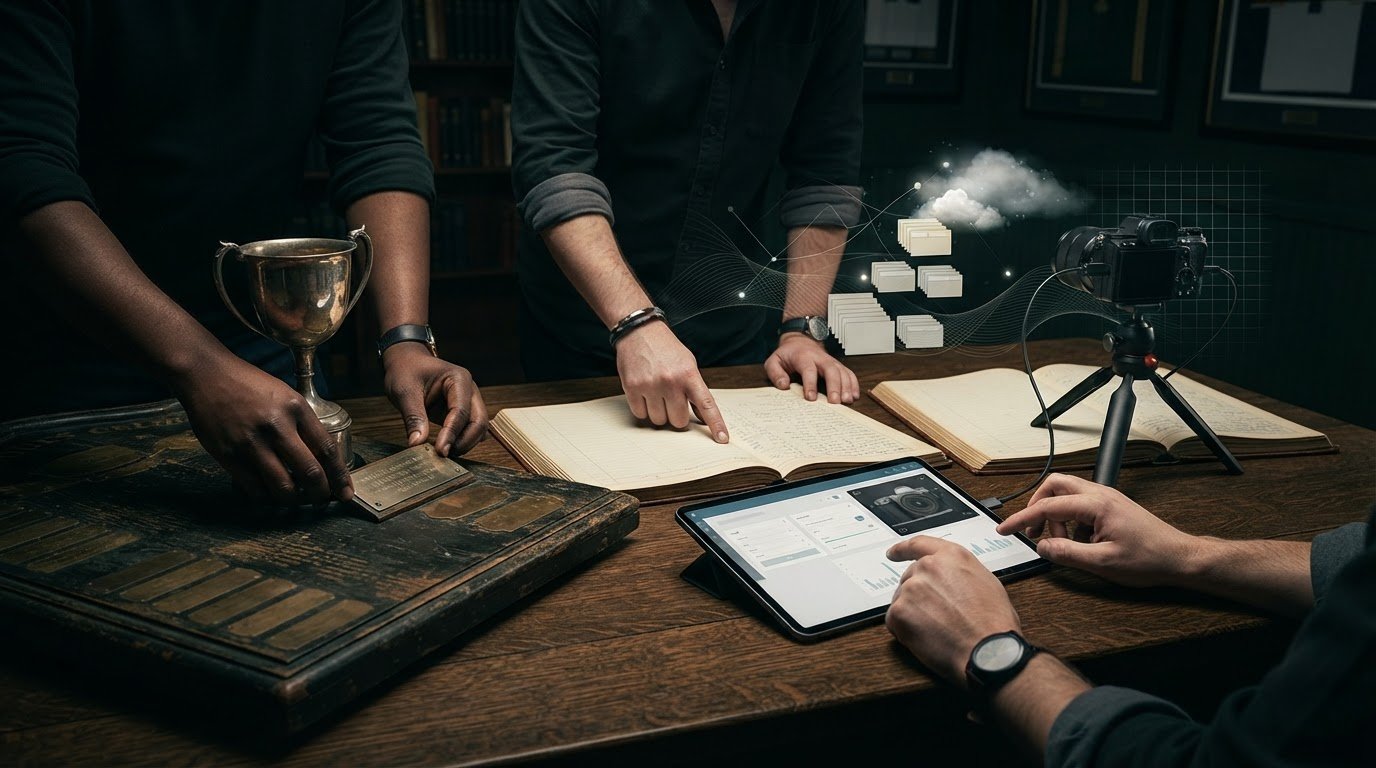
Your club's greatest achievements belong in a structured database, not trapped on tarnished silverware behind locked clubhouse glass. If you want to digitize sports club award records, the preservation challenge can easily feel overwhelming. Decades of tradition currently sit on crowded honours boards and yellowed paper ledgers, constantly exposed to fire, water damage, or gradual decay. Most volunteer committees simply don't have the technical background or endless free weekends required to manually type thousands of engraved names into spreadsheets.
You don't need to risk losing your heritage or burn out your volunteers to solve this problem. This guide shows you how to systematically convert physical trophies, honours boards, and paper ledgers into permanent digital archives. We will walk through the step-by-step workflow to extract names accurately from photos, build an accessible online archive for your community, and generate clean CSV spreadsheet backups for long-term security.
Key Takeaways
- Understand the urgent preservation risks threatening your clubhouse history, from metal oxidisation to physical record loss.
- Discover how to systematically digitize sports club award records using AI transcription directly from photos rather than exhausting manual data entry.
- Establish a structured data hierarchy that captures essential trophy context, competition grades, and recipient timelines instead of raw names.
- Implement a manageable five-step archiving workflow designed specifically for time-pressed volunteer committees.
- Protect your club's legacy with cloud-hosted interactive honours boards alongside portable CSV exports for independent spreadsheet backups.
Table of Contents
- Why Sports Clubs Must Digitize Historical Award Records Now
- Evaluating Modern Methods to Digitize Sports Club Award Records
- Core Data Architecture: What Information Must Your Club Capture?
- Step-by-Step Workflow: Transforming Club Silver into Digital Archives
- Maintaining Your Digital Archive: Future-Proofing Club Heritage
Why Sports Clubs Must Digitize Historical Award Records Now
Award record digitization is the systematic process of converting physical trophy engravings, gilded lettering, and handwritten ledgers into structured, searchable digital data. It transforms static clubhouse assets into usable institutional history. For generations, sports clubs relied on metal cups and wooden plaques to commemorate athletic excellence. Today, that physical infrastructure is reaching its natural limits. Walls run out of mounting space as new seasons conclude, while silver plate oxidises, tarnishes, and wears thin under decades of abrasive polishing. When committees choose to digitize sports club award records, they stop treating history as clubhouse furniture and start safeguarding it as verifiable data.
Centenary milestones, annual banquets, and heritage initiatives demand immediate historical accuracy. Searching through fragmented committee minutes or squinting at scratched brass plaques hours before an awards gala creates unnecessary panic. Adopting modern digital preservation strategies ensures your club captures its competitive legacy before physical materials deteriorate beyond recognition.
The Vulnerability of Physical Silverware and Honours Boards
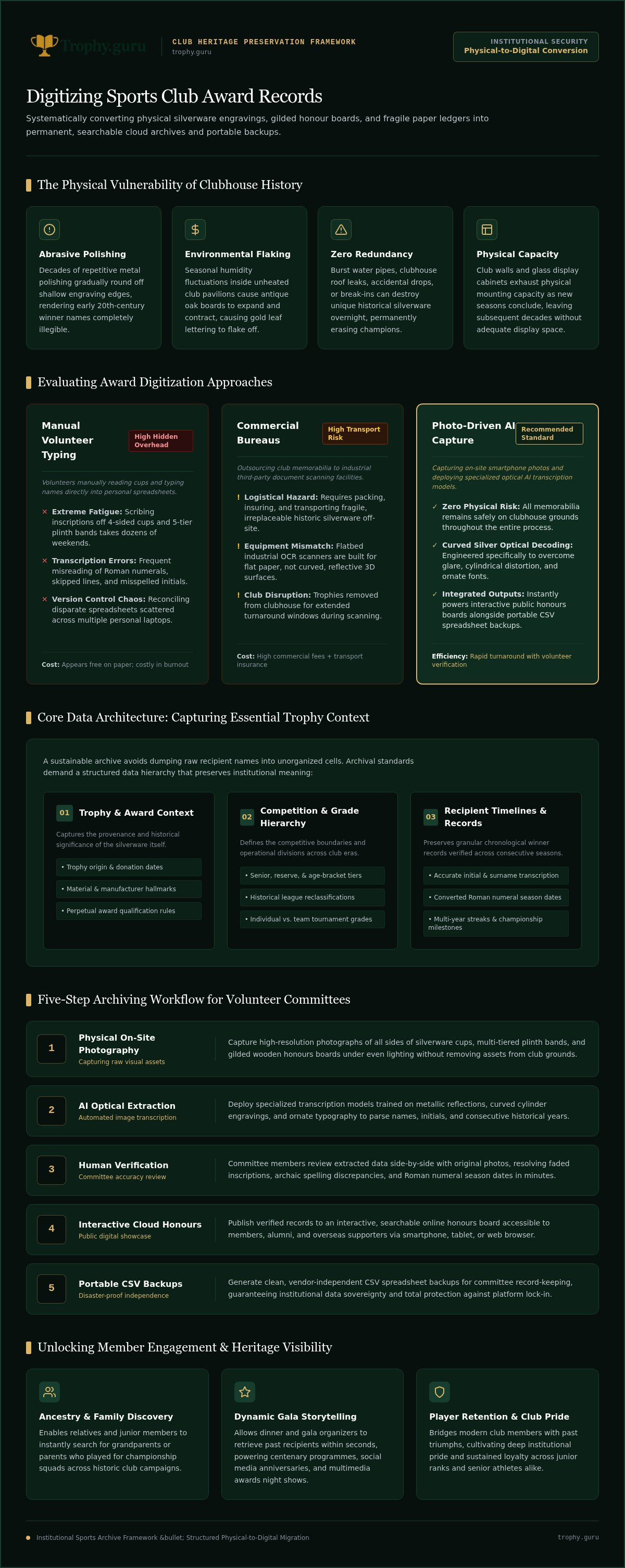
Club awards face quiet, ongoing physical threats every season. Over-polishing slowly rounds out the crisp edges of shallow engravings, making early 20th-century winner names completely illegible. Gold leaf on antique oak boards flakes away as seasonal humidity fluctuates inside unheated pavilions. More critically, physical records offer zero disaster redundancy. A burst water pipe, roof leak, accidental drop, or clubhouse burglary can erase a century of athletic accomplishments overnight. Once a piece of engraved silverware disappears without a secondary record, those champions vanish from your institution's recorded memory forever.
Unlocking Member Engagement and Heritage Visibility
Trophies locked behind glass cabinets serve only the small fraction of members who linger in the clubhouse bar. Creating an accessible digital archive turns that dormant history into an active asset. Current junior players, overseas alumni, and extended families can explore historical records from their own devices. This continuous visibility creates meaningful benefits across the club:
- Ancestry and family discovery: Relatives can quickly search for grandparents or parents who played for early championship squads.
- Dynamic event storytelling: Organizers can retrieve past winners instantly to build multimedia presentations, social media anniversary spotlights, and centenary commemorative programmes.
- Member retention: Connecting incoming athletes with decades of club tradition fosters genuine institutional pride and long-term loyalty.
Deciding to digitize sports club award records bridges the gap between past heroes and modern supporters. It ensures every hard-won triumph remains visible, celebrated, and secure.
Evaluating Modern Methods to Digitize Sports Club Award Records
Every preservation project hits a technical fork in the road early on. When committees decide to digitize sports club award records, they usually pick between three paths: recruit committee volunteers to type everything by hand, hire a commercial scanning bureau, or deploy specialized AI transcription software. The right choice depends on your budget, turnaround goals, and tolerance for logistical risk. While traditional paper documents lie flat on glass, engraved silverware presents curved, highly reflective surfaces that confuse standard optical character recognition (OCR) flatbed scanners.
To align with professional digital archiving standards, your methodology must balance speed, data fidelity, and physical preservation without putting historic silverware in harm's way.
Manual Volunteer Transcription: The Hidden Overhead
Typing records into spreadsheets looks free on paper, but it extracts a steep operational cost in volunteer fatigue. Scribing inscriptions off a four-sided cup with five tiers of plinth bands takes hours of squinting at ornate typography. Human transcribers quickly tire, introducing errors such as misread Roman numerals, mistyped initials, and skipped lines. Version control quickly unravels, too. When three different committee members maintain separate spreadsheets on personal laptops, reconciling the master document becomes an administrative headache.
Commercial Document Scanning Bureaus vs On-Site Capture
Commercial scanning bureaus deliver industrial scanning equipment, yet their services present major hurdles for physical memorabilia. Off-site processing requires packing, insuring, and couriering fragile, irreplaceable silverware away from the clubhouse. Transit introduces genuine threats of denting, scratching, or package loss. In contrast, capturing awards on-site using standard smartphone photography eliminates freight logistics, transit insurance expenses, and physical risks entirely. The trophies never leave your display cabinet.
AI-Assisted Trophy Transcription: Speed and Scalability
Modern machine learning models bypass the flaws of standard OCR by training directly on curved, mirror-finish metal and faded gilt lettering. Instead of forcing volunteers into weeks of manual entry, these algorithms extract names, competition titles, and years directly from ordinary smartphone photos. The software automatically distinguishes between donor dedications, competition hierarchies, and yearly recipient lists, structuring the output into organized data fields.
Clubs can leverage specialized AI trophy engraving transcription to process dozens of legacy cups in hours rather than months. If you want to test this workflow before digitizing an entire clubhouse collection, exploring an automated transcription tool at trophy.guru offers a practical starting point for evaluating data accuracy firsthand.
Core Data Architecture: What Information Must Your Club Capture?
Dumping raw names into an unstructured spreadsheet won't create a workable digital archive. If a cell contains only "J. Smith 1974," future club members won't know if that represents a first-team captain, a tennis singles champion, or a donor memorial cup winner. Meaningful sports archives depend on clean relational data architecture. When you digitize sports club award records, you must structure the underlying information so modern search filters can query awards by year, recipient, playing grade, or tournament tier.
Organize your data into a clear four-tier hierarchy: trophy identity (the physical artifact), historical context (its origin story), competition parameters (flight, age group, or division), and the chronological recipient entries. This structured layout integrates cleanly into modern sports club honours board software and prevents your records from turning into an unsearchable digital dumping ground.
Essential Metadata Fields for Sports Records
Capture standardized metadata across every award to ensure consistent searching and sorting across decades of competition. Focus on collecting these baseline attributes:
- Temporal data: Record exact calendar years alongside split seasons (such as "1998–99" for winter sports like rugby, football, or basketball).
- Recipient details: Track full names, initials, playing roles, team squads, and whether an entry represents an individual victor or joint titleholders.
- Artifact specifications: Note donor inscriptions, presentation dates, silversmith hallmarks, physical base materials, and dimensions.
Handling Historical Discrepancies and Incomplete Inscriptions
Club records rarely follow neat, linear patterns over a sixty-year span. Engravers frequently rotated, altering naming conventions from "Smith, J.A." in the 1950s to "John Smith" by the 1980s. Establish standardized formatting rules to clean up these historical quirks while retaining the original engraved text in a secondary field.
You also need a systematic way to handle empty seasons. Create dedicated verification flags for wartime cessations (common across 1914–1919 and 1939–1945), weather cancellations, or seasons abandoned due to facility redevelopments. When worn engravings leave lettering doubtful, don't guess. Flag the record as pending and cross-reference the date against handwritten committee minutes, fixture booklets, or bound match scorecards stored in the clubhouse archive.
Building this robust schema ensures your data remains resilient. When you systematically digitize sports club award records with complete metadata, you create a searchable asset that remains valuable for generations of future athletes.
Step-by-Step Workflow: Transforming Club Silver into Digital Archives
Converting physical memorabilia into permanent digital files doesn't require a dedicated technical background. A structured, five-stage pipeline—Audit, Photography, Automated Extraction, Human Review, and Digital Deployment—keeps the preservation process simple and manageable. When volunteer teams systematically digitize sports club award records using this phased approach, historical preservation shifts from a daunting chore into an orderly weekend project.
Step 1 & 2: Inventory Auditing and Glare-Free Photography
Start by compiling a physical inventory checklist of every perpetual cup, shield, and timber honours board in the facility. Prioritize fragile antique silverware with shallow inscriptions first, followed by wooden honours boards nearing capacity. Next, set up an on-site photo station in a well-lit area of your clubhouse. Flash photography bounces harsh hot spots off curved silver and lacquered brass, creating unreadable flares. Instead, position trophies near large windows with indirect daylight or use a simple white bedsheet to diffuse overhead strip lighting. Snap multiple overlapping photos around multi-tiered plinths to capture every engraved nameplate clearly.
Step 3 & 4: Transcription, Verification, and CSV Export
Upload your high-resolution photos into specialized transcription software that reads curved engraved typography. The platform extracts recipient names, tournament titles, and chronological dates automatically, assembling raw tables in minutes. Once processed, schedule a brief review session with two committee members. Pair older club members with newer volunteers to resolve historic nicknames, faded initials, or stylized calligraphy. After validating the names, download the completed records as a portable CSV file. This gives your club an offline spreadsheet backup that remains completely independent of any single software ecosystem.
Step 5: Publishing to Digital Honours Boards
With clean data exported, bring your history into the modern clubhouse. Verified datasets can feed directly into web-based galleries or wall-mounted interactive displays, allowing visitors to search decades of athletic achievements with a single tap. See how community organizations build engaging clubrooms with modern digital honours boards. Academic and athletic directors can also evaluate tailored school trophy digitization methods designed to connect alumni communities.
Ready to see how fast your clubhouse silver transforms into structured records? Upload a single photograph to transcribe your first trophy free with Trophy Guru and test extraction accuracy today.
Maintaining Your Digital Archive: Future-Proofing Club Heritage
A digital archive is a living record, not a static snapshot. After your committee takes the initial step to digitize sports club award records, you need a straightforward operational routine to keep that dataset current. Without a repeatable process, new championship plaques and cup engravings quickly slip through administrative cracks. Sustainable preservation balances accessible cloud hosting with independent offline backups, protecting your institutional memory against software lock-in while keeping history active across your community.
Establishing an Annual Presentation Protocol
The most convenient time to document new achievements is immediately following your annual presentation dinner. All trophies are gathered in one room, fully engraved, and accounted for. Assign a volunteer to snap clear photos of the new inscriptions before winners carry their silverware home or cups return to clubhouse display cases.
Update your records within days of the event rather than delaying until the next annual general meeting. To avoid conflicting versions and unverified duplicate entries, designate a single point of contact, such as the club secretary or honorary archivist, to manage updates and approve new entries.
Trophy Guru: The Purpose-Built Solution for Sports Clubs
Safeguarding decades of sporting achievement shouldn't burden volunteer administrators with weeks of tedious transcription. Trophy Guru provides an AI-powered platform designed specifically for curved silver cups, shields, and gilded honours boards. The software automatically translates intricate typography into structured digital tables without requiring delicate heirlooms to leave your clubhouse.
Once processed, clubs can publish mobile-friendly digital honours boards that members can explore anywhere, from the bar to their living rooms. You retain complete ownership of your historical records through instant CSV exports, ensuring spreadsheet portability whenever committee leadership changes. If you are ready to digitize sports club award records across your facility, Try one trophy free and experience automated transcription on your oldest cup today.
Safeguard Your Club's Legacy for the Next Century
Physical silverware and crowded timber plaques will always remain vulnerable to metal wear, environmental hazards, and clubhouse wall constraints. Transitioning to a structured database protects decades of hard-won athletic achievements without burning out volunteer committees. When you systematically digitize sports club award records, your history transforms from fragile clubhouse clutter into an active community resource.
Trophy Guru simplifies this archival journey. Our platform uses AI transcription purpose-built for engraved silverware, plaques, and wooden honours boards directly from ordinary smartphone photos. You maintain complete control over your records, as full CSV data export ensures your sports club retains 100% data ownership for offline spreadsheet backups. Test the process yourself; you can complete your first trophy transcription at zero cost before committing. Take the first step today and preserve your club legacy: try one trophy free on Trophy Guru.
Frequently Asked Questions
How much time does it take to digitize sports club award records?
AI-assisted transcription reduces project timelines from months to a few days. Photographing an entire trophy cabinet typically takes an afternoon. Uploading photos and running automated extraction takes just minutes per award. The longest phase is the human verification review, where two committee members validate historical names and unusual initials. Most clubs complete their full transition within a single weekend.
Can software accurately read names engraved on curved, reflective silverware?
Standard document OCR tools fail on reflective metal, but specialized models handle curved engravings and cursive scripts effectively. These purpose-built algorithms recognize depth, font variations, and multi-tier plinth layouts. Diffusing glare with indirect lighting during photography ensures the software extracts names with remarkable fidelity. Any questionable letters get flagged automatically for quick manual confirmation by your committee.
What happens if our club already has some records saved in Excel spreadsheets?
Existing spreadsheet data can easily merge into your modern digital archive. You don't have to re-enter names that someone previously recorded. You can align your Excel columns with the archive's structured metadata framework and import those legacy rows directly. This allows you to fill historical gaps by photographing physical trophies without discarding years of earlier volunteer record-keeping.
Is an internet connection required to display our digital honours board in the clubhouse?
Most digital honours board setups run through a standard web browser on a smart TV or touchscreen tablet, which needs an active internet connection to load cloud updates. However, many systems support local caching or offline kiosk modes. If clubhouse Wi-Fi drops out, the display continues showing the cached archive without interruption, automatically syncing new additions whenever the network reconnects.
How can we read heavily worn or tarnished trophy engravings accurately?
Photograph worn silverware from an oblique angle with raking light to cast small shadows inside faint grooves. This surface contrast helps both the transcription software and human reviewers decipher faded letters. If an engraving remains ambiguous, cross-reference the season against old fixture lists, annual dinner programmes, or club committee minutes rather than attempting to scrub or over-polish delicate antique metal.
Why is exporting our club award archive to CSV format so important?
Exporting to CSV guarantees complete data sovereignty and guards your club against vendor lock-in. Proprietary platforms can change features or shut down entirely. A universal CSV export ensures that your verified records remain readable in any standard spreadsheet software decades from now. When you digitize sports club award records, independent offline backups protect your heritage through every committee handover.
Can our sports club trial trophy transcription before committing our entire cabinet?
Yes, Trophy Guru allows clubs to transcribe their first trophy completely free without upfront commitment. You simply photograph your oldest cup or honours board, upload the image, and review the structured digital output yourself. This trial lets your committee verify extraction accuracy on intricate typography and inspect the exported dataset before deciding to process the remaining clubhouse collection.