What if the most valuable asset in your school's hallway isn't the silver in the trophy cabinet, but the data engraved upon it? You likely feel a deep responsibility to protect your institution's heritage, yet the reality of managing thousands of names and dates is daunting. It's frustrating to watch physical records deteriorate or remain hidden in unsearchable cabinets while you're simultaneously running out of room for new accolades. You want a solution that respects the past but utilizes the efficiency of the present.
This article shows you exactly how to digitize school trophy records to transform centuries of achievements into a searchable, permanent digital archive. We'll cover how to move from manual data entry to high-speed AI transcription, ensure your records are future-proof, and create an accessible online honours board that connects your alumni community across the globe. By the end of this guide, you'll have a clear roadmap to move from physical clutter to a streamlined, digital legacy that serves your school for the next century.
Key Takeaways
- Understand why traditional glass cabinets are insufficient for long-term preservation and how digital archives make school heritage accessible to the wider community.
- Learn how to digitize school trophy records using AI transcription technology designed to handle complex engravings on curved and tarnished silver.
- Evaluate the time-saving benefits of automated data extraction compared to manual entry to streamline your school's archiving workflow.
- Identify the essential photography and audit steps needed to prepare your collection for a seamless transition to a digital format.
- Discover how to transform static data into interactive honours boards while ensuring permanent ownership through flexible CSV exports.
Table of Contents
Why Schools are Moving Beyond the Glass Trophy Case
To digitize school trophy records is to bridge the gap between a physical object and a searchable archive. It's the process of extracting text from engravings and honours boards, then organising that information into a structured database. While a silver cup sits silently in a cabinet, its digital counterpart becomes a dynamic asset that the entire school community can access. This transition isn't just about saving space; it's about ensuring that every name etched into metal is preserved for the future.
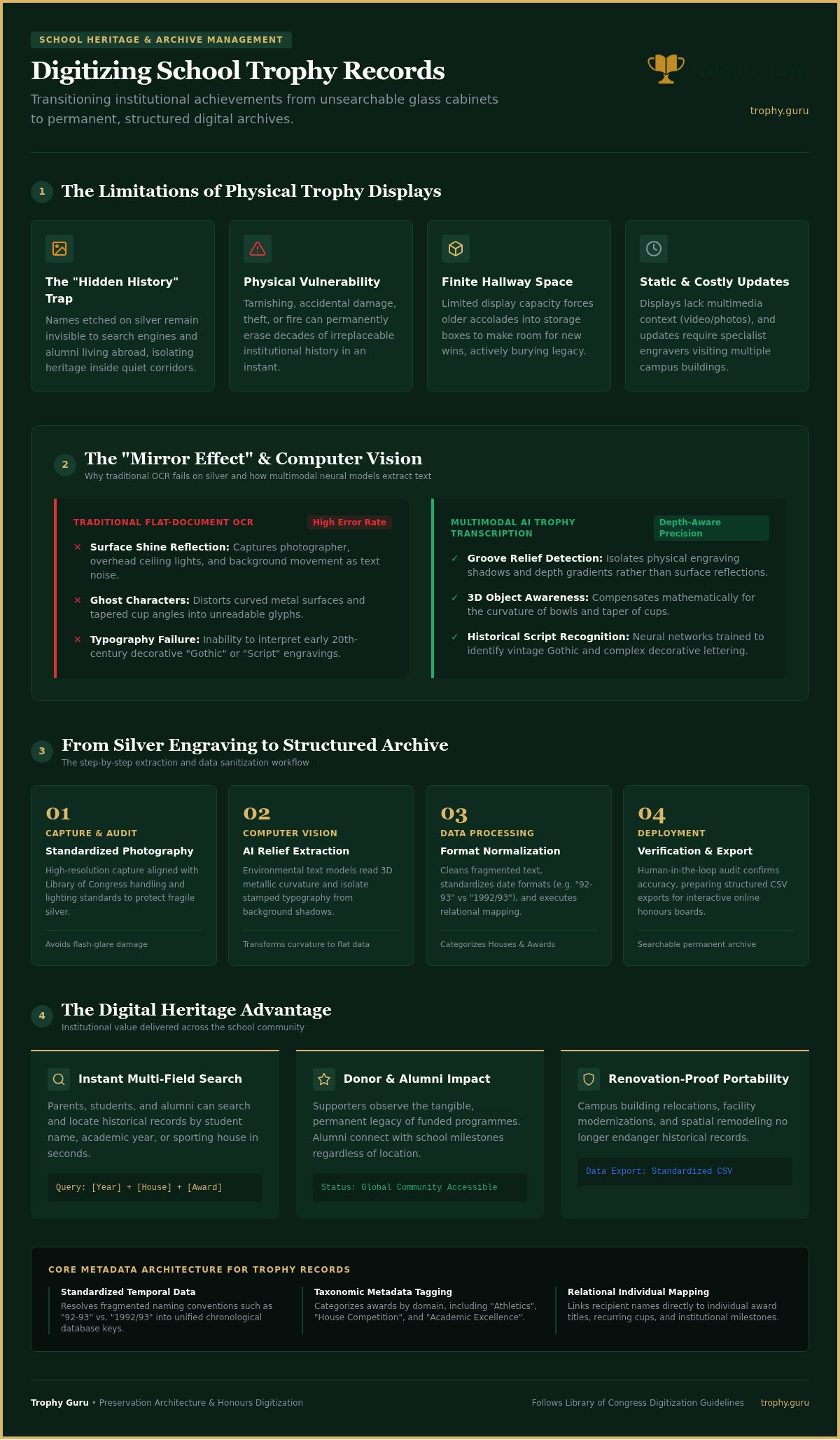
Traditional trophy cabinets often suffer from a "hidden history" problem. Names etched onto silver or brass remain invisible to search engines and alumni living abroad. These records are also vulnerable to physical risks. Tarnishing, accidental damage, theft, or fire can erase decades of school history in an instant. By moving this data into a secure cloud environment, you ensure that the achievements of past students are never lost to physical decay or disaster. This digital shift also increases engagement with your donor community, as supporters can see the tangible legacy of the programmes they fund.
The Limitations of Physical Recognition
Physical displays are inherently limited by the architecture of the school. Reception areas and hallways have finite wall space. This often forces older trophies into storage boxes to make room for new wins, effectively burying your school's heritage. These displays are also static. They provide a name and a year, but they lack the multimedia context, such as game footage or photographs, that brings an achievement to life. Updating these records is equally difficult; it's a slow process that often requires specialized engravers to visit multiple campus buildings.
The Digital Heritage Advantage
The primary benefit of a digital archive is instant searchability. Parents and alumni can find specific records by name, year, or sporting house in seconds. This accessibility strengthens the social fabric of the school, turning a dusty hallway into a point of connection for generations of students. Modern systems use advanced optical character recognition technology and computer vision to ensure high accuracy during the transition. Ultimately, a digital legacy is portable. It survives school renovations and campus moves, ensuring your history remains intact regardless of physical changes. It's a method of archiving that respects the past while embracing the efficiency of the present.
The Technology Behind AI Trophy Transcription
When you attempt to digitize school trophy records, you'll quickly encounter the "mirror effect." Polished silver and brass act as mirrors, reflecting the photographer, ceiling lights, and background movement. Traditional flat-document OCR often produces "ghost characters" or fails entirely on curved metal surfaces. Modern AI trophy transcription overcomes this by using multimodal computer vision. These models don't just look for light reflection; they isolate physical groove relief and shadow gradients to detect depth and typography.
To ensure you don't damage delicate legacy items during the capture process, it's best to follow Library of Congress digitization guidelines for handling and lighting. AI transcription is the bridge between physical heritage and digital accessibility, ensuring every engraved detail is captured with precision. By focusing on the relief of the engraving rather than the surface shine, we can extract text from even the most challenging trophies.
How AI Reads Reflective Silverware
Modern AI models are specifically trained for environmental text extraction. They recognize that a trophy is a 3D object, not a flat page. This allows the software to compensate for the curvature of a bowl or the taper of a cup. While older systems struggled with the decorative "Gothic" or "Script" fonts common in the early 20th century, contemporary neural networks are adept at identifying these patterns. They turn what was once a manual nightmare into a streamlined digital workflow.
From Photo to Structured Data
The journey from a smartphone snap to a structured CSV row involves several distinct steps. Once the AI extracts the raw text, the system cleans the data to ensure long-term integrity. This process includes:
- Standardising formats: Ensuring dates like "92-93" and "1992/93" are recorded consistently.
- Metadata tagging: Assigning categories such as "Athletics," "House Competition," or "Academic Excellence."
- Relational mapping: Linking individual names to specific years and award titles.
Accuracy is paramount when dealing with school history. Even the most advanced neural models benefit from human-in-the-loop verification. A final review pass by a human editor ensures 100% accuracy for those weathered cursive fonts and tarnished plates. This combination of speed and precision allows schools to process decades of history in a fraction of the time. If you're ready to see how this works with your own collection, you can start with a free initial trophy transcription to experience the technology firsthand.
Manual Data Entry vs. AI: Evaluating Your Approach
When you decide to digitize school trophy records, the first hurdle isn't usually the technology; it's the sheer volume of data. Manual entry often seems like a cost-effective starting point, but it quickly becomes a significant administrative burden. Typing out five decades of names from a single honours board takes hours of focused effort. When you multiply that by an entire cabinet of silverware, you're looking at a project that could stretch across months of term time. The choice between manual labour and automation determines whether your archive is completed this term or remains a permanent item on the "to-do" list.
The Hidden Costs of Manual Transcription
Human fatigue is the primary enemy of archival accuracy. After transcribing fifty names from a reflective surface, a staff member's attention naturally wanes. This leads to "transcription drift," where dates are swapped or surnames are misspelt. Before you even begin the data entry phase, it's vital to follow Library of Congress preservation guidelines for digitizing materials to ensure you handle the items safely without causing further wear. Even with perfect preparation, the "volunteer bottleneck" is a reality for many schools. Alumni associations often start heritage projects with high enthusiasm, but the repetitive nature of manual typing leads to burnout. This stalls the project, leaving your records half-finished and unsearchable for years.
Why AI is the Modern Standard
AI transcription offers a level of scalability that manual entry simply can't match. It processes an entire trophy's worth of engravings in seconds rather than minutes. While a person might struggle to decipher tarnished script or curved text, a neural network identifies these patterns with consistent precision. This ensures that your formatting remains uniform across the entire archive, from the oldest 19th-century cup to last year's sports day shield. For schools with smaller or niche collections, pay-per-trophy models are particularly cost-effective because you only pay for the data you actually extract.
Utilising specialized AI trophy engraving transcription services allows you to bypass the technical hurdles of data cleaning and formatting. It's a methodical way to move from physical clutter to a structured, future-proof database. By choosing an automated approach, you protect your school's most valuable resource: the time of your staff and volunteers. You aren't just saving names; you're creating a portable legacy that's ready for the next century of school history.
Preparing Your School Records for Digitization
Before you begin the technical process, a thorough audit of your collection is essential. Start by identifying every item that holds institutional value, including silver cups, wooden shields, and large wall-mounted honours boards. To successfully digitize school trophy records, you must define which data points matter most to your community. Most schools prioritise the recipient's full name, the year of the award, and the specific category, such as "First XI Cricket" or "Senior Debating." You might also include metadata like the student's house or the name of the donor who originally gifted the trophy. Establishing these database fields early prevents the need for re-indexing later in the project.
Photography Tips for Reflective Surfaces
The quality of your digital archive depends on the clarity of your source images. When photographing silverware, avoid using a direct flash, as this creates "hot spots" that obscure the text. Instead, set up your station in a room with plenty of indirect, natural light. Position the trophy so the light reveals the depth of the engraving without creating harsh reflections. For curved items like bowls or tall cups, capture multiple angles to ensure the AI can read text that wraps around the surface. A consistent, neutral background, such as a grey or navy cloth, helps the software isolate the trophy from the environment and improves transcription accuracy.
Organising the Workflow
Efficiency comes from a methodical approach to file management. Group your trophies by department or era before you start snapping photos. For example, processing all "Academic Excellence" awards in one batch allows for faster metadata tagging. Use a clear naming convention for your files, such as Year_AwardName_PhotoNumber.jpg, to keep your records organised during the upload phase. Large honours boards require a different strategy; photograph them in overlapping sections rather than trying to capture the entire board in one distant shot. This ensures the text remains sharp enough for the computer vision models to process.
Proper preparation ensures your data is ready for a seamless digital honours board integration. By categorising your records during the audit, you make it easier for alumni to navigate the final searchable database. It transforms a physical task into a structured digital workflow that respects the history of the objects. If you're ready to see how your photographs translate into structured data, you can start today with AI trophy transcription for your first item.
From Digital Archive to Interactive Honours Board
Once you digitize school trophy records, the information should not remain a static file on a hard drive. It must evolve into a living honours board that actively serves your community. This transition moves your heritage from a "dead" archive to an interactive asset that builds school spirit. While some providers focus on selling expensive, proprietary touchscreen hardware, a software-first approach is more resilient. It allows your records to be accessible on any device, from a smartphone in an alumnus's hand to a display screen in the school reception.
The Searchable Honours Board
A searchable honours board enables anyone to find a specific name, year, or achievement in seconds. This global accessibility is a powerful tool for alumni engagement, as former students can reconnect with their history from anywhere in the world. You can add significant value by linking contextual media to each entry. Team photographs, scanned match reports, and digital yearbooks turn a simple name into a complete story. Because the system is digital, you can update it annually with ease, ensuring the records remain evergreen without the cost of physical engraving.
These digital records also serve as effective assets for fundraising and networking events. You can display specific achievements via QR codes at dinners or use the data to identify distinguished alumni for school awards. It's a three-step cycle of engagement: search the name, view the record, and share the memory. This process transforms a dusty hallway into a digital hub that connects generations of students through their shared successes.
Long-term Data Security
Data portability is the most critical factor in future-proofing your school's history. You must insist on CSV or Excel exports to maintain full ownership of your records. This prevents "vendor lock-in" and ensures your archive survives even if software platforms change. Cloud hosting provides the best balance of security and accessibility, but it should be paired with regular local backups. By using open data formats, you ensure that the records you capture today will remain readable by the technology of the future. This methodical approach protects your legacy while making it a functional part of school life.
Securing Your School's Digital Legacy
The transition from physical clutter to digital order is a necessary step for any institution that values its history. By moving beyond the limitations of glass cabinets, you transform static engravings into a searchable, living archive that connects with alumni across the globe. You've learned how specialized AI transcription bypasses the mirror effect of reflective silver and why a software-first approach ensures your data remains portable and secure. These steps move your records from dusty shelves into a format that truly serves your community.
Now is the time to digitize school trophy records before physical decay or space constraints erase these achievements. Trophy Guru provides the tools to modernise your heritage with AI-powered accuracy and full CSV data export for long-term ownership. We are trusted by schools and sports clubs nationwide to act as modern guardians of tradition. You can digitize your first school trophy for free with Trophy Guru to experience the efficiency of automated transcription firsthand. Protecting your school's legacy has never been more achievable.
Frequently Asked Questions
How long does it take to digitize an entire school trophy collection?
The time required depends on the size of your collection, but the AI transcription process itself takes only seconds per item. While your team might spend a few afternoons on the initial audit and photography, the automated extraction is significantly faster than manual typing. Most institutions can digitize school trophy records and launch a searchable archive within a single academic term. This efficiency allows you to preserve decades of history without a massive time commitment.
Can AI accurately read very old or faint engravings on silver?
Yes, modern computer vision models are specifically designed to identify text on weathered or tarnished surfaces. These systems detect the physical groove relief and shadow gradients rather than relying on surface light reflection. This allows the technology to decipher faint engravings that might be difficult for the human eye to see clearly. We also utilise human-in-the-loop verification to ensure 100% accuracy for the most challenging historical items in your collection.
Do we need to send our trophies away for transcription?
No, your trophies never need to leave the school premises. The transcription process is entirely remote and is performed using photographs you capture on-site. This ensures your valuable heritage items remain secure and protected from the risks of transport. Since we don't offer on-site photography services, your staff or volunteers simply follow our lighting guidelines to snap photos using a standard smartphone or digital camera for upload.
What is the best way to photograph curved trophies for AI?
The best method involves using indirect natural light and capturing multiple overlapping angles. You should avoid using a direct camera flash, as the resulting glare often obscures the engraved text. For curved surfaces like silver bowls or tall cups, take photos from the left, centre, and right. This ensures the AI can accurately reconstruct text that wraps around the object. A consistent, neutral background also helps the software isolate the trophy relief.
Can we export our school trophy records to Excel or CSV?
Yes, full data portability is a core feature of our service through CSV Archive Export. This ensures your institution maintains complete ownership of its records in a format compatible with Microsoft Excel or other database systems. Exporting your data is a vital step in future-proofing your school's history. It allows you to keep local backups and easily integrate your trophy records with existing school management software or alumni directories.
How do digital honours boards handle historical data from wooden boards?
Digital honours boards process wooden records by analysing high-resolution, sectioned photographs of the physical boards. Because these items are often large, we recommend photographing them in segments to maintain the sharpness required for accurate transcription. The AI extracts the names and years from each section, merging them into a single searchable database. This allows you to consolidate records from silver trophies and wooden boards into one unified, interactive digital display.
Is there a limit to how many names can be stored in a digital archive?
No, there is effectively no limit to the number of records your digital archive can hold. Unlike physical glass cabinets that are restricted by hallway dimensions, cloud-hosted databases scale to accommodate centuries of school history. This unlimited capacity makes it the perfect solution for large institutions with extensive athletic and academic records. You can continue to modernise your archive every year, adding new accolades without ever needing to remove older achievements.
What happens to the data if we stop using a specific software provider?
You retain full ownership of your records through our CSV export functionality. If you decide to stop using our hosting services, you can download your entire structured archive at any time. This prevents vendor lock-in and ensures your school's heritage is never lost if you change platforms. Because we use open data formats, the records you capture today will remain readable and portable for any future database or management system you choose.