

A club’s history is rarely lost all at once. It slips away one handover at a time: minutes remain in a cupboard, photographs stay on a former officer’s phone, and trophy inscriptions are difficult to search. Managing historical records for a private club starts with recognising that these scattered items hold both practical value and the story of the community.
The task can feel large, especially when volunteers have limited time and responsibilities change. A workable system doesn’t require organising everything in one push. It needs clear ownership, sensible priorities and a plan for keeping records findable and accessible.
This guide explains how to take stock of what the club holds, decide what deserves ongoing care and assign manageable responsibilities for access and handovers. It also covers storage, digital preservation and ways to make selected history easier for members to explore. For engraved honours, searchable digital transcription can make names and dates easier to find while complementing, not replacing, care of original records.
Key Takeaways
- Start managing historical records for a private club by listing what the club holds and where each record is kept.
- Agree who coordinates the inventory, looks after significant material and approves access, so responsibility survives committee changes.
- Use consistent descriptions for physical and digital records to preserve context and make future searches easier.
- Build a repeatable review routine that fits volunteers’ time and can adapt as the archive grows.
- Make selected honours and club history easier for members to explore while keeping digital access within the club’s wider archive policy.
Table of Contents
- Managing Historical Records for a Private Club Starts with Knowing What You Hold
- Set Club Record Ownership, Roles, and Access Before Records Disappear
- Organise Physical and Digital Club Records Without Losing Their Context
- Create a Sustainable Routine for Reviewing and Preserving Club Records
- Make Selected Club Records Searchable and Useful to Members
Managing Historical Records for a Private Club Starts with Knowing What You Hold
A club’s history lives in more than formal documents. Committee minutes, constitutions, membership lists, ledgers, event programmes, photographs and correspondence can show how the organisation made decisions and changed over time. Trophies, plaques, honours boards, result sheets and digital files record achievements and traditions too.
Together, these records can explain not only what happened, but who was involved and why it mattered. A programme without a date or event details may be hard to interpret later. A result sheet linked to a named competition, year and trophy inscription tells a fuller story. Record context, names, dates and provenance, meaning where an item came from and how the club acquired it, so future readers can make sense of the evidence.
A club archive is material selected for lasting value, described so it can be understood, cared for and accessed. This is one practical application of records management principles: records need context and thoughtful handling throughout their life, not just a place to sit. The first goal isn’t to catalogue everything perfectly. It’s to find out what exists and decide where to begin.
Which records may hold lasting value for a private club?
Look for records that document governance, participation and the club’s distinctive story. Start with committee minutes, constitutions, membership lists, correspondence, event programmes and photographs. Then consider honours boards, trophy engravings, results and accounts of notable achievements. Routine records may serve immediate administrative needs, while selected items can have lasting historical value. Keep related material together where possible: a photograph, programme and results sheet from the same event are more informative as a group.
How can a club begin an inventory without getting overwhelmed?
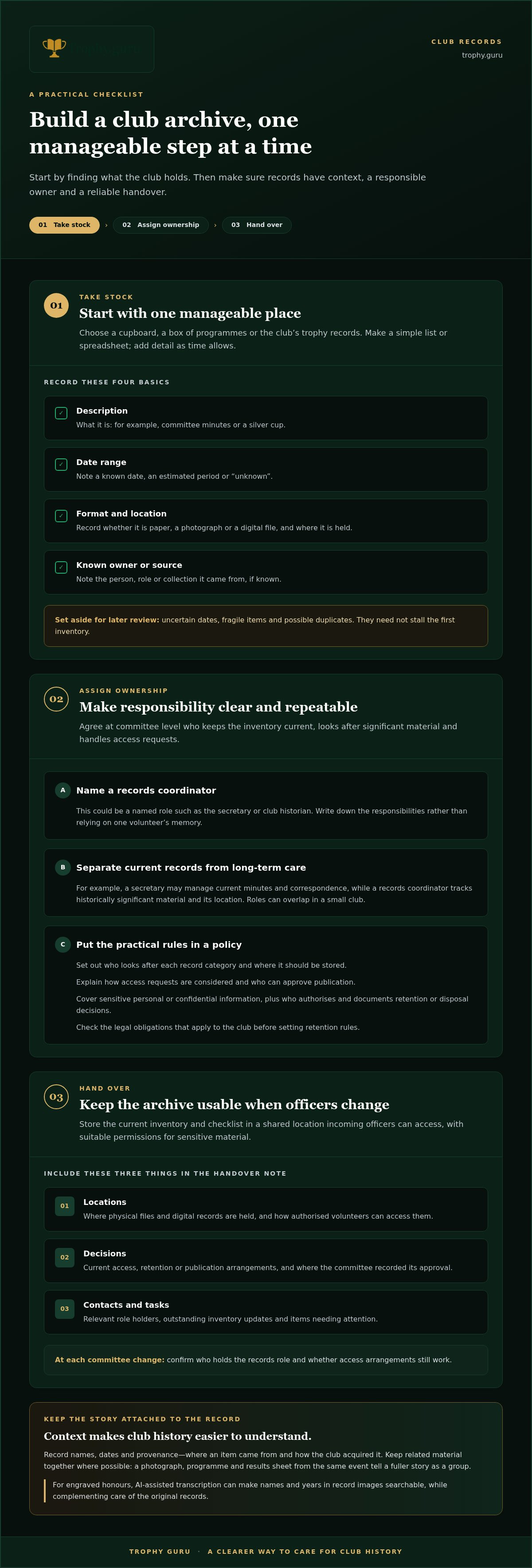
Choose one manageable starting point, such as a cupboard, a box of programmes or the club’s trophy records. Create a spreadsheet or simple list and record the basics first. Add detail as time allows. For each item or group, note:
- Description: what it is, such as committee minutes or a silver cup.
- Date range: a known date, estimated period or “unknown”.
- Format and location: paper, photograph or digital file, plus where it is held.
- Known owner or source: the person, role or collection it came from, if known.
Flag uncertain dates, fragile items and possible duplicates for later review instead of letting them stall the inventory. For engraved honours, AI-assisted transcription can turn names and years in record images into searchable information. The inventory gives the club a clear starting map. Decisions about access, care and responsibility can follow.
Set Club Record Ownership, Roles, and Access Before Records Disappear
An inventory is only useful if someone keeps it current. Agree at committee level who coordinates the records, updates the inventory and handles access requests. These responsibilities can sit with one named role, such as the secretary or club historian, rather than depending on a particular volunteer’s memory. Set out how questions or sensitive decisions should be raised with the committee.
Separate day-to-day record keeping from long-term care. A secretary may manage current minutes and correspondence, while the designated records coordinator tracks historically significant material and ensures each item has an identified location. The roles can overlap in a small club, but write down what each person is responsible for. That distinction helps make managing historical records for a private club more consistent as officers change.
What should a club records policy cover?
Keep the policy practical and proportionate. Explain which records the club creates, who looks after each category and where it should be stored. Set out how access requests are considered, who can approve publication, and how the club handles sensitive personal or confidential information. For retention and disposal, record who authorises decisions and how they’re documented. Check any legal obligations that apply to the club before setting retention rules; don’t assume every record can be kept or shared without restriction.
The National Archives guidance on records management offers an example of structured oversight, though it’s written for US federal records. A club can apply the general lesson by assigning responsibility and documenting procedures, while setting its own policy around applicable UK requirements and circumstances.
How can a club make volunteer handovers reliable?
Build continuity into the handover instead of relying on the outgoing volunteer’s memory. Store the current inventory and checklist in a shared location that incoming officers can access, with suitable permissions for sensitive material. At each committee change, confirm who holds the records role and whether access arrangements still work.
A concise handover note can capture:
- Locations: where physical files and digital records are held, and how authorised volunteers can access them.
- Decisions: current access, retention or publication arrangements and where the committee recorded its approval.
- Contacts and tasks: relevant role holders, outstanding inventory updates and items needing attention.
For engraved honours, a searchable online board can help members explore names and achievements while complementing the club’s wider records policy. Explore searchable digital honours records to make selected club history easier to find.
Organise Physical and Digital Club Records Without Losing Their Context
Physical and digital records need different kinds of care, but both need clear descriptions and a reliable link to their source. A paper minute book may carry signatures and annotations that matter as much as its text. A digital result sheet may be easy to search but difficult to interpret if its filename says little about the event or date. Build a system for both formats rather than assuming one storage method suits every record.
| Record format | Useful strengths | Things to plan for |
|---|---|---|
| Physical originals | May retain material details such as handwriting, annotations, signatures or the object’s construction. | Need a known location, suitable handling and storage, and a way for members to find them without unnecessary handling. |
| Digital files and copies | Can be searched, shared with authorised readers and linked to related records. | Need clear filenames and descriptions, managed access, backups and ongoing checks that files remain usable. |
A digitised copy can improve access and reduce repeated handling, but it doesn’t automatically replace care of the original. Keep a clear connection between a scan or photograph and its source, including the original’s location. For a focused workflow, see this club award-record digitisation guide.
How should a club describe records so members can find them later?
Choose consistent terms for people, teams, events, competitions and record types. Describe what’s known and mark uncertainty rather than filling gaps with guesses. A useful description might include the item’s title, date or date range, event, format, source and physical location or digital filename. Use the same name for a competition across related records, even if older documents use a shortened version.
Connections matter. Link a result sheet to the relevant photograph and trophy inscription so members can trace an achievement across formats. If an engraved name or year is unclear, record it as uncertain and retain the image for reference. Careful description preserves meaning as well as the item itself, making it central to managing historical records for a private club.
When can digitisation make club history easier to use?
Consider digitising records that members request often, fragile items that need careful handling, or material that’s difficult to consult in its current location. For engraved honours, AI-assisted transcription can extract names, years and details from images and place them in a searchable online archive. Structured records can also be exported as CSV for further organisation. Keep the original’s location and any uncertainty visible alongside the digital record, so easier access doesn’t come at the cost of context.
Create a Sustainable Routine for Reviewing and Preserving Club Records
A one-off sorting day can create a useful starting point, but it won’t keep an archive current. New records arrive, volunteers change, and digital files can become harder to locate or open. A light, repeatable routine is more sustainable than waiting for time to complete a full overhaul.
Use a four-step cycle. Keep each stage small enough to fit around normal volunteer duties:
- Collect: bring newly created or discovered records into the club’s agreed system.
- Describe: add enough information to identify each item and its context.
- Review: check descriptions, locations, access arrangements and unresolved questions.
- Improve access: make suitable records easier to locate while keeping restricted material appropriately protected.
Choose a review interval the club can maintain, then record it in the records policy. The right schedule depends on how often records are created and who can do the work. A brief check alongside a committee cycle may suit one club; another may prefer a less frequent, planned review. Consistency matters more than an ambitious timetable volunteers can’t sustain.
What should a practical club records review include?
Check that new material has been added to the inventory with useful descriptions. Confirm that listed records are still where the inventory says they are, and review whether their storage and access arrangements remain suitable. Note uncertain ownership or incomplete descriptions so they don’t disappear from view.
Finish by recording decisions and assigning a person and next step to each action. Carry unfinished tasks into the next review or committee handover. Simple measures show progress without turning the process into a reporting burden: track items added to the inventory, descriptions needing attention and actions completed since the last review. This helps reveal where the archive is improving and where more work is needed.
How can a club improve access while protecting sensitive material?
Separate records that are appropriate for general member access from material that may need restrictions. Make access decisions in line with club policy, the sensitivity of the information and applicable requirements. Clear descriptions and a searchable list can answer routine enquiries without requiring volunteers to search cupboards or personal files each time. Review permissions as roles change, and record who can approve access or publication.
For related planning ideas, use this club history preservation checklist. Managing historical records for a private club is ongoing work, but steady improvements build continuity over time. For selected engraved honours, make club trophy records searchable with AI-assisted transcription and an online archive that complements the wider records system.
Make Selected Club Records Searchable and Useful to Members
An archive becomes more meaningful when members can use it. Searchable records can help someone trace a family connection, prepare for an anniversary, check past competition results or bring a club story to life. Start with records that have clear value and a defined audience instead of trying to publish the entire archive at once.
Which club records are good candidates for a searchable honours board?
Trophy inscriptions, competition winners, honours boards and result sheets are useful starting points when they document notable achievements. Search and browsing work best when entries use consistent categories and include details such as the person or team, year, event title and competition. These details help distinguish similar names and make it easier to follow an award across seasons.
A digital honours board can give members a route into selected information. It doesn’t replace the club’s wider records policy, inventory or care of original material. For ideas on presenting honours online, read this digital honours boards guide.
How can AI-assisted transcription fit into a wider archive plan?
Trophy Guru uses AI-assisted transcription to extract names, years and other details from images of trophies, honours boards and result sheets. The information can become part of a searchable online archive, helping members find selected club achievements without relying on someone to read each inscription manually. Check extracted text against the source image, especially if an engraving is worn, unclear or difficult to distinguish. Keep uncertainty visible instead of treating a suggested reading as certain.
Structured records can also be exported as a CSV file for further organisation and record keeping. This lets the club work with the data beyond the member-facing archive, while keeping transcription focused on relevant honours records rather than treating it as a replacement for broader archive management.
Managing historical records for a private club doesn’t require a complete digital collection before members see a benefit. Choose one well-defined set, such as a particular competition’s past winners, and make sure its names, dates and categories are clear. A free initial trophy transcription offers a practical way to begin making engraved records searchable. Small, well-documented steps can make club history easier to discover and share.
Start Building a Club Archive That Lasts
Managing historical records for a private club becomes more manageable when you know what you hold, give people clear responsibilities and keep a steady review routine. Start with a focused record group, describe it clearly and make access decisions that respect the material and the people represented in it. Progress can be gradual. Each well-documented handover helps preserve club knowledge for the future.
Selected trophy and honours-board records can also become easier for members to explore. Trophy Guru uses AI-assisted transcription to extract names, years and details from record images, then makes them available in a searchable online archive. CSV export supports further organisation, and a free initial trophy transcription offers a straightforward way to try the process with a focused set of honours.
Explore Trophy Guru’s searchable club records and choose the honours your members would most value finding. Start with one focused collection to make your club’s history easier to preserve and share.
Frequently Asked Questions
How should a private club start managing its historical records?
Start by making a simple inventory of one manageable area or record category, rather than trying to organise everything at once. Note each item’s description, date range, format, location and known source. Flag uncertain details, fragile material and possible duplicates for later review. This first overview helps the club understand what it holds and decide what needs care, clearer descriptions or improved access.
What historical records should a private club keep?
Consider records that document the club’s decisions, achievements and traditions. These may include constitutions, committee minutes, membership lists, correspondence, ledgers, event programmes, photographs, result sheets, trophy inscriptions and honours boards. Their lasting value often depends on context, such as who was involved, when an event took place and where an item came from. Set retention and disposal decisions through club policy, taking relevant obligations and the sensitivity of information into account.
Who should be responsible for a club’s historical records?
The committee should agree a named role responsible for coordinating the records, maintaining the inventory and raising questions about access or care. This might be the secretary, club historian or another volunteer, depending on the club’s structure. Day-to-day record keeping can remain with the officers who create records, while the coordinator oversees material selected for long-term value. Write down responsibilities so the system belongs to the club, not just one person.
How can a private club protect records when committee members change?
Keep the inventory, records policy and handover checklist in a shared location that incoming officers can access appropriately. The handover should state where physical and digital records are held, how authorised volunteers can access them, what decisions are in place and which tasks remain outstanding. Review permissions and responsibilities after committee changes. A brief, up-to-date note helps prevent records and knowledge from being lost with a departing volunteer.
Should a club digitise all its historical records?
No. Digitisation can make selected records easier to search and share, but scanning everything may create unnecessary work and doesn’t remove the need to care for originals. Prioritise frequently requested, fragile or hard-to-access material, and keep each digital copy linked to its physical source. Use clear descriptions and suitable access controls. A gradual approach lets the club make useful records available while developing its wider archive plan.
Can AI transcribe names from a club trophy or honours board?
Yes. Trophy Guru uses AI-assisted transcription to extract names, years and other details from images of trophies, honours boards and result sheets. The resulting information can be browsed in a searchable online archive and exported as CSV for further organisation. Review extracted text against the source image, particularly where an inscription is unclear. A free initial trophy transcription is a practical starting point for selected honours records.