
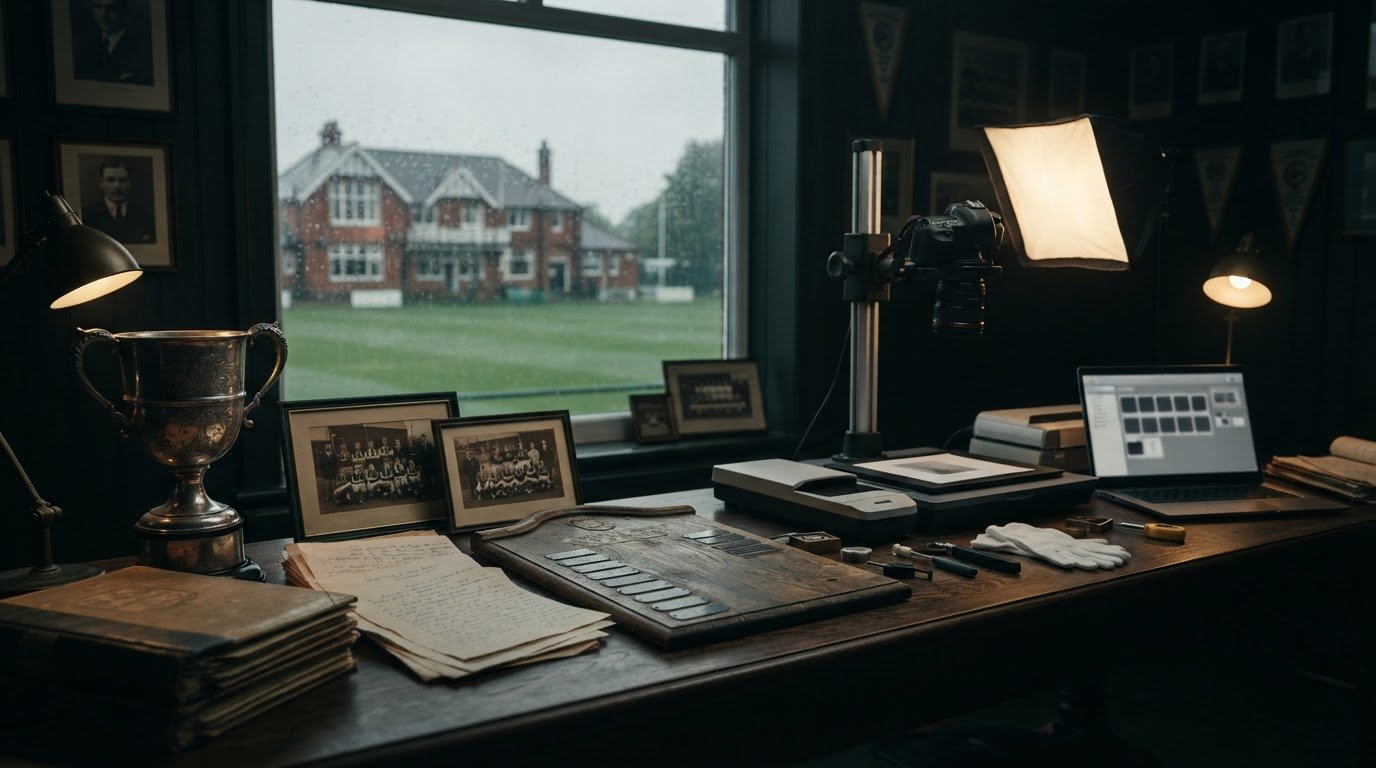
What if digitising a football club’s history didn’t mean scanning every item in the same way? A trophy inscription, an honours board, a team photograph and a box of paper records each need a method that captures what makes them useful. That’s the practical challenge of football club history digitization: preserving images and objects while recording names, dates and context accurately.
Club history is often spread across display cases, photographs and documents, with details held in volunteers’ memories as much as in written records. The task can feel daunting, especially when time is limited and reflective surfaces or worn lettering make inscriptions hard to read. A digital copy is only useful if members can find the information they need.
This guide compares practical digitization methods for different record types, then sets out a manageable plan for bringing the results into one searchable archive. You’ll learn how to organise and check transcribed details, preserve original records and make club history easier to share. For trophy, plaque and honours-board records, AI-assisted transcription can help capture engraved names and years, while searchable online access and CSV export support ongoing club record-keeping.
Key Takeaways
- Match the capture method to the record: photography, scanning and manual entry each suit different club-history materials.
- Make football club history digitization manageable by starting with a small group of records and following a clear workflow.
- Record each item’s title, year, people, competition and source so details remain useful beyond the digital image.
- Keep uncertain readings distinct from confirmed facts, and preserve original spellings to support accurate club records.
- Turn verified honours details into searchable records, with online access and CSV export supporting future use.
Table of Contents
- Football club history digitization: what to preserve and why
- Compare football history digitization methods by record type
- Build reliable digital football records without losing context
- Plan a manageable football club digitization project
- Turn digitized football records into a searchable club archive
Football club history digitization: what to preserve and why
Football club history digitization means capturing records, describing what they show and organising the information so people can find and use it. It can bring honours boards, trophy engravings, programmes, photographs, minute books and result sheets together in a more accessible account of the club’s past.
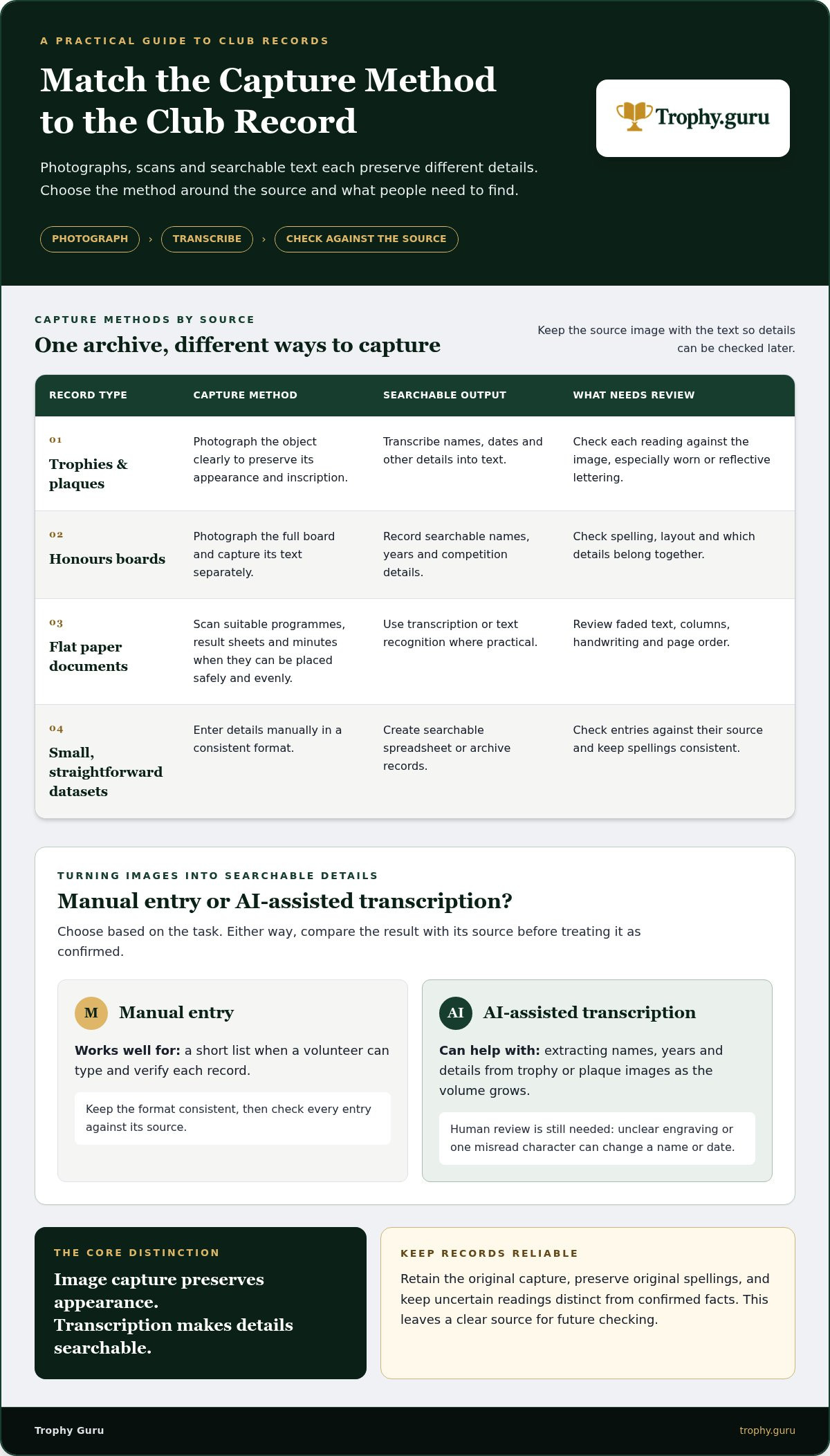
Image capture creates a digital picture of an item; transcription turns readable details into searchable text. A photograph of an honours board preserves its appearance, while a transcription of the names and years lets a member search for a particular winner. Both are valuable. Keep the source image alongside the text so the details can be checked later.
Which football club records are worth digitizing first?
Begin with records that contain names, dates or results members regularly ask about. Make a simple inventory, separating physical objects, paper documents and existing digital files. For each item, note where it is kept, its approximate date range, its condition and any known gaps. This gives volunteers a clear starting point and helps prevent incomplete or difficult records from being overlooked.
- Physical objects: trophies and honours boards, including engraved names and dates.
- Paper records: programmes, minute books and result sheets.
- Existing digital files: photographs, documents or spreadsheets already held by the club.
Also list missing years and unreadable inscriptions. This separates what the club has from what still needs research, without presenting uncertain details as fact.
How digitization helps preserve club identity
Accessible records can help current members discover the teams, achievements and volunteers who shaped the club. A former player’s name on a board becomes easier to find, and a result sheet can add context to a photograph. Keep original spellings and retain the source material with each transcription. Future readers can then see where a detail came from and revisit unclear readings.
Digital files need ongoing care to remain usable. The broader principles of digital preservation include maintaining access to digital information over time. Digitisation supports this work, but it doesn’t replace caring for the original trophy, photograph or document. For a practical companion to organising records for long-term access, see this guide to preserving club history online.
Compare football history digitization methods by record type
The right method depends on the source and what the club needs to do with the result. A photograph preserves an object’s appearance, while searchable text makes names and dates easier to look up. For football club history digitization, consider legibility, layout, image quality and intended use before choosing how to capture each record.
| Source type | Capture method | Searchable output | Review needs |
|---|---|---|---|
| Trophies and plaques | Photograph the object clearly | Transcribe names, dates and details into text | Check each reading against the image, especially worn or reflective lettering |
| Honours boards | Photograph the full board and capture text separately | Searchable names, years and competition details | Check layout, spelling and which details belong together |
| Flat paper documents | Scan suitable programmes, result sheets and minutes | Use transcription or text recognition where practical | Review faded text, columns, handwriting and page order |
| Small, straightforward datasets | Enter details manually in a consistent format | Searchable spreadsheet or archive records | Check entries against their source and keep spellings consistent |
Photography and scanning for club history sources
A clear photograph preserves visual details a text-only record can’t, such as a trophy’s shape, an inscription’s position or the arrangement of an honours board. Photograph three-dimensional objects from an angle that makes the lettering easy to read. Scan flat documents when they can be placed safely and evenly. Plaques need particular care when being recorded, so see this guide to archiving commemorative plaques. Keep the original capture with any transcribed text.
Manual entry versus AI-assisted transcription
Manual entry can work well for a short list when a volunteer can type and verify each record. As the volume grows, AI-assisted transcription can help extract names, years and details from trophy or plaque images, but the result still needs human review. Engraved lettering may be unclear, and one misread character can change a name or date. Compare every result with its source before treating it as confirmed.
For an example of this approach, read about an AI trophy engraving transcription service. Trophy Guru uses AI-assisted transcription to turn trophy, plaque and honours-board records into searchable digital data, with online archive access and CSV export. The practical guide to digitizing school sports history also offers planning ideas for sports organisations deciding what to capture and how to organise it.
Choose a method based on the task, not the novelty of the tool. If searchable honours records are the priority, Trophy Guru’s digital archive can help organise verified transcriptions.
Build reliable digital football records without losing context
A transcription is most useful when it explains what the record refers to and where the information came from. Give each item a consistent record containing a title, year, people involved, competition and source. Add fields such as season, team, source type and notes when they help members search for or understand the entry.
Searchable records rely on consistent names, dates and source references, so every result can be found and checked against its evidence. Choose a standard format for dates and names, then use it throughout the archive. For example, use the same date order in every entry and decide how to handle team names that changed over time. Keep a separate field for the wording as it appears on the original, so standardised search terms don’t erase historical spellings or phrasing.
Choose fields that make records searchable
Keep the structure simple enough for volunteers to maintain. A trophy entry might include the competition, season, winning team, engraved names, source type and a note identifying the trophy or image. A result-sheet entry may need the match date, teams and result instead. Collect only the personal details needed to describe the club’s history. Extra information can create more work without making records easier to find.
Check transcriptions and keep an audit trail
Review names, dates and competition titles against the clearest available source image. If a character or word can’t be read confidently, mark it as uncertain rather than guessing. Preserve the original image and connect it to the transcription through a file name, archive reference or other consistent identifier. Later volunteers can then revisit the evidence without searching through unrelated files.
An audit trail can be straightforward. Record who checked an entry and when, along with any correction made. If a later review changes a reading, note the change rather than silently replacing the earlier transcription. This leaves a clear path from source to searchable record and makes disagreements easier to resolve.
Set a consistent standard for source images and apply it across the project. Clear, well-framed captures make text easier to review and reduce uncertainty during transcription. Adapt the process to the records and resources your club has. A dependable archive isn’t built by collecting the most fields. It’s built by recording useful details consistently, linking them to evidence and checking them in a way volunteers can sustain.
Plan a manageable football club digitization project
A successful football club history digitization project doesn’t need to begin with every record the club owns. Start with a defined batch, agree what “complete” means for that batch, then improve the process before expanding. The scope depends on the volume and condition of the records, so avoid setting expectations around an arbitrary deadline.
Use a repeatable sequence:
- Inventory: list the records and note their format, location and condition.
- Prioritise: select a useful, manageable first group.
- Capture: photograph objects or scan suitable documents.
- Transcribe: turn relevant names, dates and results into text.
- Verify: check entries against their source material.
- Organise and share: file records consistently and decide who can access them.
Set priorities around club needs
Choose records linked to frequent member questions, an upcoming anniversary or a known gap in the club’s history. Weigh their historical value against legibility, access needs and the time volunteers can give. For example, a clear set of honours records may be a more achievable first batch than a mixed box of fragile, incomplete papers. Write down what this phase includes and what can wait. A clear boundary helps the team finish and learn from the process.
Assign responsibilities, even if one person takes more than one role. Decide who handles and returns physical sources, who enters the data, who checks it and who updates the archive as new results arrive. A shared checklist can show each record’s progress without relying on one volunteer’s memory.
Choose how members will find and use records
A spreadsheet can be a practical working tool for structured details such as seasons, teams and winners. An online archive can make approved records easier for members to browse. The two approaches can work together: keep working data orderly, then share selected records in a format suited to discovery.
CSV is a portable file format for tabular data. It can help clubs move rows of records between compatible tools, though it won’t preserve every layout or image. Keep source files connected to the corresponding entries, and decide which information is suitable for public viewing versus club-only access. Base that decision on the material and the people represented in it.
For searchable honours records with online browsing and CSV export, explore Trophy Guru’s digital archive as part of your club’s digitization plan.
Turn digitized football records into a searchable club archive
Once names, years and competition details have been transcribed and checked, they can become structured honours records rather than information locked in a photograph. Members can search or browse the club’s achievements, while the source material remains available to check how each detail was recorded. This is where football club history digitization moves from capture to everyday use.
From trophy image to searchable honours board
A practical workflow is straightforward: add a source image, extract the visible text, review names and dates against the source, then organise confirmed details into records. Trophy Guru uses AI-assisted transcription to extract names, years and details from photographs of trophies, plaques and honours boards, as well as result sheets. Human review remains important, particularly where engraving is unclear. Keep the image connected to its transcription and flag uncertain readings, so future volunteers can revisit the evidence instead of relying on an unverified guess.
With Digital Honours Board Hosting, verified records can be browsed online. Members can look up past winners without relying only on a physical display or knowing which cupboard holds the relevant paperwork. The archive complements the original trophy or board; it doesn’t replace the object or its care.
Keep the archive useful as club history grows
A searchable archive needs a simple maintenance routine. Assign someone to add new results, check names and dates, and keep entries consistent with the club’s chosen fields. When volunteers change, clear records and a repeatable review process help preserve continuity. Keep source images accessible alongside the corresponding entries, especially where a reading remains uncertain or may benefit from later research.
CSV export provides a portable copy of tabular archive data that can be reused in compatible tools for club record-keeping. It’s a useful way to retain names, years and competition details in rows and columns, but a CSV won’t contain the original images or preserve every archive display feature. Keep those source files and their links to the records as part of the archive.
Trophy Guru offers one free initial trophy transcription. To put the workflow into practice, try one trophy free and start preserving club records.
Start building an archive your club can use
Football club history digitization works best when each record is captured in a suitable way, described consistently and checked against its source. Begin with a manageable group that answers real questions from members, then build on a process volunteers can maintain.
Keep source images linked to transcriptions, preserve original spellings and mark uncertain details rather than guessing. Once verified, names, years and competition details can form searchable honours records that are easier to browse and reuse. A CSV export also gives the club a practical copy of its tabular archive data for record-keeping.
Trophy Guru uses AI-assisted transcription to help extract details from trophy, plaque and honours-board images, with searchable online archive records. One free initial trophy transcription gives your club a straightforward way to begin with a single record. Review the result and decide how it fits into your wider archive.
Try one trophy transcription free and take the first step towards making your club’s history easier to find, preserve and share. Start small. Each carefully recorded detail helps keep the story accessible for the members who come next.
Frequently Asked Questions
What does football club history digitization involve?
Football club history digitization means turning historical sources into organised digital records people can find and use. A project may capture photographs or scans of trophies, honours boards, programmes and result sheets, then record searchable details such as names, years and competitions. Check unclear readings and link each transcription to its source. Digital access makes records easier to explore, but it doesn’t replace caring for the original physical items.
How should a football club start digitizing its history?
Start by listing the records the club holds and noting which questions members ask most often. Choose a manageable first group, such as a set of honours-board entries, then capture each source, transcribe relevant details and check uncertain readings. Store the source image with its record so it can be reviewed later. A clearly scoped first phase gives volunteers a process they can maintain before expanding the archive.
Can AI transcribe names from football trophies?
Yes, AI-assisted transcription can help extract visible names, years and other details from trophy or plaque photographs. Treat the result as a draft, not a verified record: glare, worn lettering and unusual engraving can make characters difficult to distinguish. Compare the transcription with the clearest source image, retain that image with the record and flag unclear text rather than guessing. This keeps automated assistance useful without losing accuracy or context.
What is the best format for a digital football club archive?
The best format depends on how the club will manage and share its records. A spreadsheet can organise structured information such as seasons, competitions and winners, while an online archive can make approved entries easier for members to browse. Use consistent fields and keep original images connected to records. CSV provides a portable way to move tabular data between compatible tools, though it doesn’t contain images or preserve every display feature.
How can a club make digitized football records searchable?
Use consistent formats for names, dates, competitions and other key details, then give each record descriptive fields such as season, team, award and source type. Similar entries should follow the same conventions so searches return useful results. Keep original spellings where they differ from standard forms, and note uncertain readings rather than silently correcting them. Link records to their source images so future volunteers can check details and maintain the archive.
Should a football club digitize trophies or honours boards first?
Choose the source that best matches the club’s priorities, the questions members ask and the condition of the material. Honours boards often present winners and years in a structured way, while trophy engravings may hold additional details. Consider how legible each source is and what volunteers can manage. Start with a small, useful group, capture its source material and verify the transcriptions before deciding which records to digitize next.