
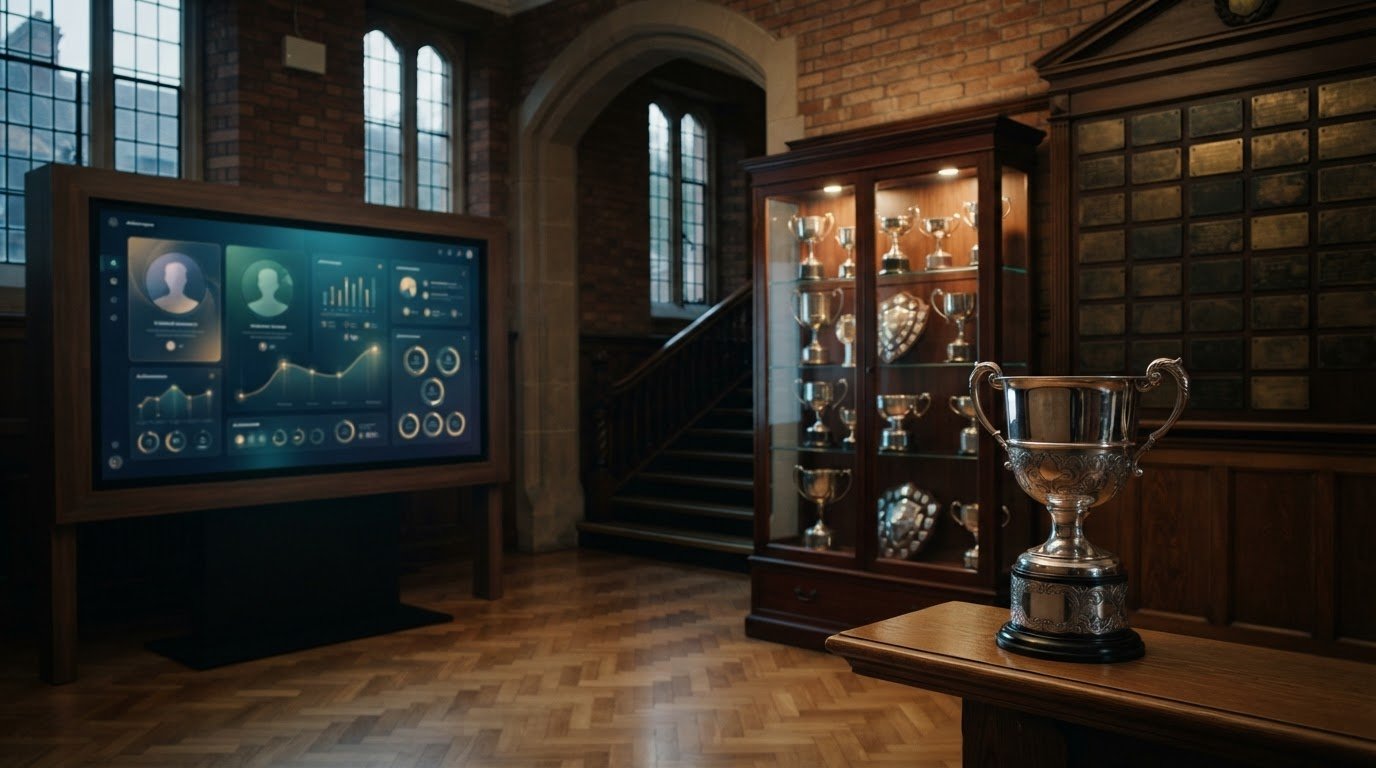
Walking through the school foyer, you see them: rows of wooden boards with faded gold lettering and glass cases packed with silver cups. These items represent decades of achievement, yet the names are often unreadable, and the boards themselves ran out of space years ago. Transitioning to a digital recognition board for schools solves this, moving your history from static wood to an interactive display. Updating physical records is slow and expensive, creating a logistical burden for busy administrative teams.
You likely agree that your school’s heritage deserves more than a dusty corner or a locked cabinet. This 2026 guide provides everything you need to know to make the switch successfully. We'll explore how to move your history into the digital age, the specific hardware requirements for educational environments, and how AI transcription can digitise 50 years of trophy engravings without the manual data entry slog. By the end, you'll have a clear roadmap to celebrate your past while reclaiming your office's time and space. It's time to ensure your school's legacy is searchable, secure, and ready for the future.
Key Takeaways
- Learn how to transform static, limited-space archives into a searchable digital recognition board for schools that parents and alumni can access from anywhere.
- Discover how AI-powered transcription eliminates the daunting task of manual data entry for decades of legacy trophy records and wooden honours boards.
- Understand why software flexibility and data portability via CSV exports are more critical to your school's legacy than the specific physical hardware you choose.
- Explore ways to enhance historical records with multimedia content, turning simple engraved names into engaging stories of student achievement and school history.
- Identify cost-effective strategies for auditing your physical collection and testing the digitisation process with a free initial transcription.
Table of Contents
What is a Digital Recognition Board for Schools?
A digital recognition board for schools is a centralised digital hub designed to store and showcase student achievements, alumni records, and institutional history. It serves as a modern successor to the traditional trophy cabinet. While physical trophies and wooden plaques have long symbolised excellence, they present significant logistical challenges. Physical honours boards are finite; they eventually run out of wall space. Engraved silver cups require regular polishing and secure storage. By moving these records into a digital environment, schools can preserve their heritage without the physical clutter or recurring maintenance costs.
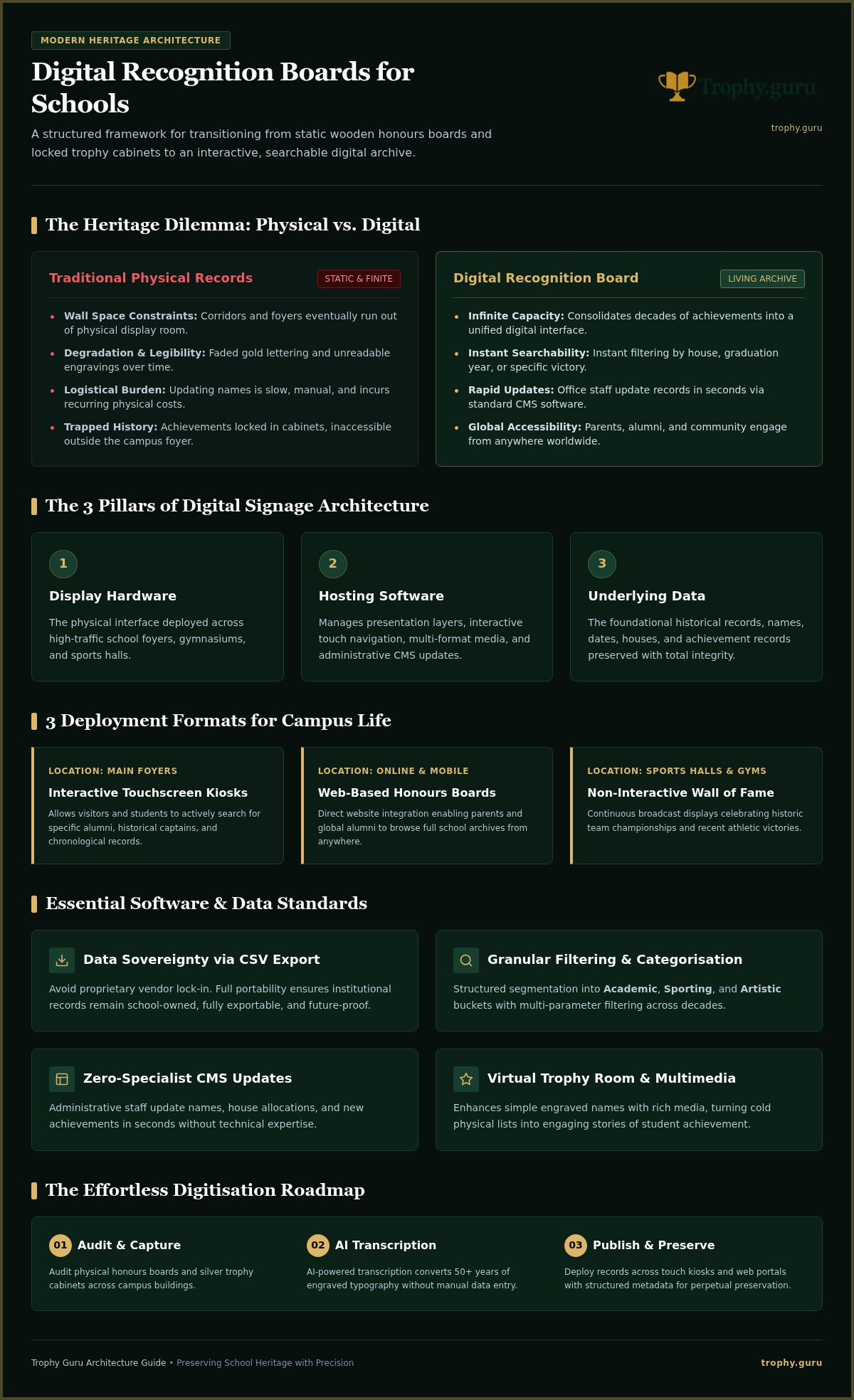
Setting up this system requires an understanding of digital signage architecture, which involves three core components. First, the display hardware provides the visual interface. Second, the hosting software manages the content and user interaction. Finally, the underlying data acts as the foundation, containing the names, dates, and achievements that make the board valuable.
The Evolution of School Honours Boards
The transition from hand-painted gold leaf on oak boards to high-definition pixels reflects a shift in how educational communities engage with their past. Many older school buildings suffer from the "wall space" problem, where every available corridor is already lined with historical records. A digital recognition board for schools solves this by condensing decades of history into a single, searchable interface. This evolution also breaks down geographical barriers. Instead of achievements being "trapped" in a hallway, they become accessible to parents and alumni globally through web-based portals. It turns a static record into a living archive that can grow indefinitely.
Types of Digital Recognition Displays
Schools typically deploy these systems in three distinct formats depending on their specific goals. Interactive touchscreen kiosks are common in high-traffic foyers, allowing visitors to search for specific names or years. Web-based honours boards integrate directly into the school website, providing a permanent digital archive for the community. Finally, non-interactive digital "Wall of Fame" displays are often found in sports halls or gymnasiums to celebrate recent athletic victories and historic team records. Each type ensures that school heritage remains a visible, active part of daily campus life, providing a professional way to showcase the legacy of the institution.
Key Features to Look for in School Recognition Software
Choosing the right software for a digital recognition board for schools is about more than aesthetics; it's about building a robust architecture for your history. You need a system that balances accessibility with security. High-quality software ensures that your records aren't just seen, but are usable and transferable. The software should act as a bridge between the physical legacy of the past and the digital expectations of the future.
Data sovereignty is a critical consideration for any educational institution. You must ensure that your records remain your own. Look for platforms that offer CSV exports of your entire archive. This portability prevents vendor lock-in and ensures that your decades of data aren't trapped in a proprietary format. A user-friendly Content Management System (CMS) is equally vital. It allows the school office to update names, houses, and achievements in seconds without needing specialized technical training.
Searchability and Data Integrity
A static list or a simple PDF is a digital dead end. Searchable databases allow users to filter by house, year, or specific achievement. This level of granularity is essential for managing school trophy databases effectively. It ensures that a student from 1974 is as easy to find as a current captain. Proper categorisation into Academic, Sporting, and Artistic buckets keeps the archive organised and respectful of diverse talents. Accuracy is paramount here; the software must allow for easy verification and editing of records to maintain long-term data integrity.
Alumni Engagement and Public Access
A digital recognition board for schools shouldn't be confined to the physical lobby. By creating a "Virtual Trophy Room," you allow alumni to reconnect with their achievements from anywhere in the world. When you begin the process of converting your records, following the National Archives digitization guidelines for metadata and file naming helps ensure your digital files remain accessible for decades. QR codes placed on physical displays can act as portals, linking visitors to deeper digital stories, photos, and videos of historical events. This fosters a sense of continuity and school pride that a static wooden board cannot achieve. If you want to see how easily your records can be converted, you can start with a free trophy transcription to test the system's accuracy.
Hardware vs. Software: Choosing the Right Setup
Hardware fails. Data persists. When planning a digital recognition board for schools, it's easy to focus on the physical screen, yet the underlying software and archive data are far more critical. A high-quality commercial interactive panel represents a significant capital investment. However, that screen will eventually reach its end of life. If your records are tied to a proprietary hardware system, you risk losing decades of history when the monitor is replaced. Future-proofing your investment means choosing a software-first architecture where your records exist independently of the display device.
Cloud-based hosting is now the standard for educational archives. It removes the burden of maintenance from the school's local IT team and ensures the archive is accessible from any device. This approach allows for total data portability. By maintaining your records in a flexible format, you ensure that your school's legacy can migrate to new hardware as technology evolves without the need for expensive data recovery or manual re-entry.
Evaluating Display Hardware
Investing in commercial-grade monitors is essential for long-term operation. Consumer TVs often lack the anti-glare coatings and heat management systems required for constant use in school foyers. Using a consumer screen in a public environment typically voids the manufacturer's warranty. For interactive touchscreens, adherence to inclusive design standards is vital. Screens must be mounted at a height that ensures accessibility for all users, including those in wheelchairs. You should also consider mounting options; recessed walls provide a sleek, professional look, while freestanding kiosks offer flexibility in sports halls or gymnasiums.
The Software Engine: What Powers the Board?
The most effective platforms are web-first, meaning they run in a standard browser and work on any screen. This flexibility is central to modern campus digital signage and student engagement strategies, as it allows the school to centralise communications and celebrate achievements across multiple locations simultaneously. Security remains a top priority. Your chosen system must manage student data with strict privacy controls, particularly for public-facing displays. Modern digital recognition board for schools installations must ensure these digital interfaces conform to WCAG 2.1 Level AA standards to remain accessible to all. Choosing a software partner that understands these regulatory requirements is just as important as the hardware itself.
How to Digitise Decades of School Records Effortlessly
The biggest hurdle in implementing a digital recognition board for schools isn't the budget or the hardware; it's the "Data Debt." This term refers to the decades of unrecorded history trapped on physical objects. Most school digitisation projects fail because the prospect of manually typing thousands of names from 50 years of silver cups and wooden boards is overwhelming. A single honours board can contain hundreds of names, and a full trophy case represents a monumental administrative task. Manual entry is a project killer.
To overcome this, follow a methodical four-step workflow. Start with a comprehensive audit of your physical collection to identify every item that requires recording. Once audited, move to the photography phase using a standard smartphone. The third step involves using AI transcription to extract text directly from these images, bypassing manual entry entirely. Finally, verify the extracted data against the original photo and import it into your digital archive. This process turns a months-long project into a manageable task for the school office.
AI Transcription: The Game Changer for Schools
Traditional OCR software struggles with the curved, reflective surfaces of silverware or the faded gold leaf on dark wood. Modern AI transcription, however, is specifically designed to handle these environmental challenges. It can read worn engravings on a 1920s cup just as easily as a modern plaque. This automation makes digitising school trophy records both fast and cost-effective. By using AI to handle the heavy lifting, school staff can focus on the accuracy of the records rather than the tedium of typing.
Photographing Your Legacy for Digital Archives
Success in transcription starts with clear source material. When photographing historical silverware, avoid using a direct flash, as this creates hot spots that obscure the engraving. Instead, use soft, indirect lighting from the side to create contrast within the letters. For long honours boards, take several overlapping close-up photos rather than one distant shot to ensure the AI can resolve the smallest details. Organise these photos into folders by category, such as "Athletics" or "Academic Honours," before you begin the upload process. This structured approach ensures a clean transition to your new digital recognition board for schools. If you're ready to clear your data debt, start your digital archive with a free transcription today.
Implementing a Modern Recognition Board with Trophy Guru
Trophy Guru acts as the essential bridge between a school's physical heritage and a modern digital recognition board for schools. By focusing on the data first, it ensures that historical records are preserved with meticulous accuracy before they are displayed. The process begins with a risk-free entry point. The "Try One Free" model allows administrators to test the AI transcription on their most challenging piece of silverware or most faded honours board. This verification step builds trust in the technology's ability to handle complex, reflective surfaces that traditional software often fails to read.
Once the records are digitised, the platform provides a searchable, web-accessible interface that serves your entire community. This digital archive is not just a replacement for wooden boards; it's an expansion of your school’s story. It allows for the inclusion of detailed narratives and high-resolution illustrations that physical plaques simply cannot accommodate. By centralising these records, you create a living history that remains relevant to current students while honouring the achievements of those who came before.
The Trophy Guru Workflow for Schools
The transition from physical clutter to digital order follows a clear, logical progression. First, take high-resolution photographs of your existing hall of fame plaques or trophy cabinets using a standard smartphone. Second, upload these images to the secure platform where the AI performs the heavy lifting of extracting names, years, and categories. Third, review the extracted data side-by-side with the original photo to ensure absolute accuracy. Once verified, you can publish the records to your school’s dedicated digital honours board, making them instantly searchable for students, parents, and alumni.
A Cost-Effective Solution for Every Department
Budget constraints often hinder long-term digitisation projects, but a modular approach provides a sustainable path forward. Instead of high monthly fees, Trophy Guru uses one-time transcription fees that fit comfortably into annual departmental budgets. This "pay once for more" model is particularly advantageous for schools with extensive historical collections. There are no hidden monthly subscriptions for basic record hosting, ensuring the school's history remains accessible without recurring financial pressure.
Data sovereignty is a core value of the platform. Every school retains full ownership of its records. You can use the CSV archive export feature at any time, ensuring your heritage is never "locked in" to a single provider. This transparency allows for total data portability, giving you the freedom to manage your archives as you see fit. If you are ready to preserve your legacy, you can modernise your school records today with Trophy Guru.
Securing Your School's Legacy for the Future
Transitioning to a digital recognition board for schools is a strategic move that preserves your institutional history while reclaiming valuable physical space. By prioritising software flexibility and data portability, you ensure that your records remain accessible through every hardware upgrade. The most significant barrier to this transition, decades of manual data entry, is now a thing of the past. AI-powered transcription provides 100% data accuracy, allowing you to recover names and dates from even the most reflective silverware or worn wooden boards in minutes.
You can now build searchable archives that honour your school's legacy without the administrative burden of typing. Trusted by schools to preserve heritage with precision, this system bridges the gap between traditional honours and modern accessibility. It's time to move your history out of the glass case and into the hands of your community. Digitise your school records with Trophy Guru. Your school's past is too valuable to leave to chance. Start your journey today and ensure every achievement is recorded for generations to come.
Frequently Asked Questions
How much does it cost to digitise a school’s entire trophy collection?
Costs are structured around a one-time fee per trophy rather than a recurring subscription. This "pay once for more" model is designed to be budget-friendly for educational institutions with large legacy collections. You can test the accuracy of the system with a free initial transcription before committing to a larger project. This approach allows departments to scale their digitisation efforts at their own pace, ensuring every historical record is captured without an ongoing financial burden.
Can digital recognition boards display historical records from 50+ years ago?
Yes, these boards are specifically designed to preserve legacy records spanning several decades. The AI-powered transcription engine can extract names and dates from curved silver cups and wooden honours boards regardless of age. By converting these physical records into a digital recognition board for schools, you ensure that achievements from 50 or even 100 years ago are searchable and secure. This process protects your school's heritage from the physical decay of traditional materials.
What is the best hardware for a school hall of fame display?
Commercial-grade interactive touchscreens are the standard choice for hall of fame displays. Unlike consumer TVs, these screens feature anti-glare coatings and are rated for continuous daily operation in high-traffic hallways. When planning your installation, ensure the hardware is mounted at an ADA-compliant height to remain accessible to all students and visitors. A software-first approach ensures that your data remains portable, even if you decide to upgrade the physical screen in the future.
How do we update the digital board after our annual prize-giving ceremony?
Updating your archive is a simple three-part process following each ceremony. First, take a clear photograph of the new engraving or updated honours board. Second, upload the image to the platform for AI transcription. Third, verify the extracted data and publish the update to your live board. This workflow eliminates the need for manual data entry and ensures your searchable digital archive remains current with minimal administrative effort from the school office staff.
Is it possible to export school honours data if we change platforms later?
Yes, you maintain full ownership of your school's honours data at all times. The platform includes a CSV archive export feature, which allows you to download your entire historical record in a portable format. This ensures that your school is never locked into a single provider. You can move your data, integrate it with other management systems, or keep a secure offline backup, providing total sovereignty over your institution's important historical achievements.
Do we need a professional photographer to digitise our trophies?
You don't need a professional photographer to begin digitising your collection. Most modern smartphones capture sufficient detail for the AI transcription engine to work effectively. The key is to use soft, indirect lighting to avoid glare on reflective silver surfaces and to take overlapping photos of long honours boards. While Trophy Guru does not provide on-site photography, the system is designed to be user-friendly enough for any staff member or student volunteer to manage.
How does AI transcription handle old, faded engravings on wooden boards?
AI transcription is highly effective at reading faded gold leaf or worn engravings on dark wood grain. The system uses advanced computer vision to distinguish between the texture of the wood and the actual characters of the text. This technology is significantly more reliable than manual entry, especially when dealing with hundreds of names. It recovers information that might otherwise be lost to time, ensuring your digital recognition board for schools remains a complete record.
Can parents access the digital recognition board from home?
Parents and alumni can access the digital archive from any location with an internet connection. The searchable digital honours board is web-hosted, meaning it can be embedded directly into your school's existing website or shared via a dedicated link. This remote access allows families to celebrate student achievements from home and helps alumni reconnect with their school history. It transforms a hallway display into a global engagement tool that strengthens the entire school community.